
Reviewed · EVORA & ALENTEJO DAY TRIPS
Tour Évora and Alentejo in a private tour
The surprise here is cork. Before reaching Évora, you visit a traditional cork facility and see how tree bark becomes wine stoppers, flooring, bags, shoes, and other goods. I like that this is not just a drive to a famous town, but a look at a working Portuguese industry. I also like the chance to explore Évora with guides such as João Costa or Anastasiya, who are praised for clear storytelling and easy conversation.
The private format gives you room to slow down, adjust the order of stops, and choose between a long lunch, more church time, or extra wandering inside the walls. Hotel, apartment, or cruise-port pickup makes the day simple. The tradeoff is distance: Évora is roughly a substantial drive from Lisbon, so about three hours of the nine-hour day can be spent on the road.
Key points to know before booking
- The cork factory is a genuine highlight: See cork selected and prepared by hand, then browse finished products.
- Évora packs several centuries into a walkable center: Roman ruins, medieval walls, Gothic churches, an aqueduct, and tiled houses all fit into one day.
- Private means flexible: Your guide can adjust the pace, lunch timing, and emphasis according to your interests.
- The Chapel of Bones is unusual and serious: Human skulls and bones line the interior, making it a reflective stop rather than a lighthearted attraction.
- The cathedral visit can be especially rewarding: An extra ticket allows access to the interior and, according to tour experiences, the upper levels and views.
- The drive is part of the price: Round-trip transport saves planning, but this is a full-day outing rather than a quick hop from Lisbon.
Why this day trip feels different from a standard Évora visit
Évora is already a good reason to leave Lisbon. It is an old walled city with Roman remains, medieval lanes, whitewashed buildings, churches, and a central square that still organizes the town. The cork stop gives the outing a second subject, one rooted in the Alentejo rather than only in monuments.
I especially like that combination. A sightseeing day can become a parade of façades and dates. Here, you also see how a local material is harvested and turned into useful objects. The result is a more grounded understanding of Portugal, from rural production to royal churches and Roman engineering.
The outing lasts about nine hours and begins around 8:30 a.m. Pickup is available at your hotel, apartment, or Lisbon cruise port. You ride in an air-conditioned private vehicle with WiFi and a guide accompanying you at the monuments. The price is listed at $169.31 per person, with group discounts available.
That price deserves a practical reading. It is not the cheapest way to reach Évora, since public transport or a self-planned visit may cost less. You are paying for door-to-door transport, a private vehicle, a guide, and the ability to change the pace. For two or more people who value convenience and personal attention, that can be fair value. Museum and monument tickets are extra, and lunch is not included.
A few other Lisbon half-days worth a look
- Évora and Megaliths Full-Day Tour from Lisbon
★ 4.7 · 456 reviews - Évora and Monsaraz with Regional Wine Tasting from Lisbon
★ 4.5 · 229 reviews - Private Day Tour With Guide to Évora and Monsaraz
★ 5.0 · 134 reviews
The cork factory is the unexpected star
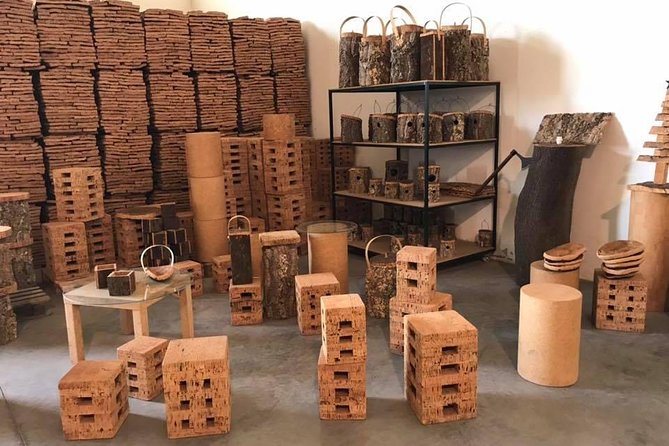
The first stop, Corticarte, introduces you to cork in a direct and useful way. You learn about the cork oak, the removal of its bark, the preparation of the raw material, and the finished products. The visit lasts about an hour and has no admission charge.
Portugal produces about 55 percent of the world’s cork, so this is not a novelty added merely to fill time. Cork oak bark can grow to a considerable thickness and is removed about every nine years, after which the tree regenerates its bark. The material is prized because it resists heat, cold, and fire, and because it is light and flexible.
You also learn why cork remains important in wine production. A cork stopper allows tiny portions of oxygen to reach the wine, helping it age while preserving its quality. That small detail changes how you look at the next bottle you open.
The facility is described in the tour experiences as a modest working place, more like a barn than a polished museum. I consider that a plus if you want to see production close up. Some of the work is done by hand, and the shop carries a wide range of cork goods, including decorative items, bags, shoes, and products that resemble fabric.
Allow time for browsing, but remember that shopping is optional. The stop is valuable even if you buy nothing. It gives the Alentejo countryside a practical identity before you reach Évora’s grand buildings.
Walking inside Évora’s medieval walls
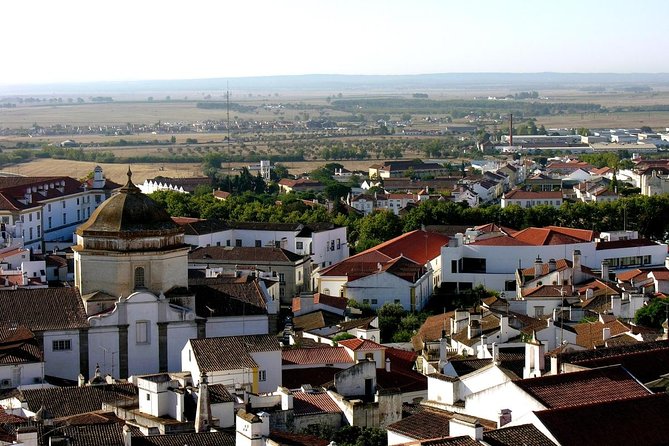
The historic center covers about 107 hectares and is enclosed by more than three kilometers of medieval walls. You walk through narrow lanes, small squares, patios, and broad public spaces, with the guide connecting the visible buildings to Évora’s long sequence of Celtic, Roman, Arab, Jewish, and Christian influence.
The city’s finest period came in the 15th century, when Portuguese kings made Évora a residence. That royal connection helps explain the quality of its churches and civic buildings. White houses, tiled details, wrought-iron balconies, and irregular lanes give the center a character quite different from Lisbon’s larger urban scale.
The listed timing for the general historic-center visit is about 45 minutes, but the actual walking time is spread across the day as you move between individual sights. Wear comfortable shoes. The streets are old, and the best way to understand the center is on foot.
The private setup matters here. You can ask for more explanation at a church, pause to take photographs, or spend time in the shops along Rua 5 de Outubro, known for Alentejo handicrafts. You are not tied to a large group waiting at every corner.
Aqueducts, churches, and the shape of the old city
The Água de Prata Aqueduct is an impressive piece of Renaissance engineering. Inaugurated in 1537 during the reign of João III, it was designed and built by Francisco de Arruda, the architect associated with the royal court. It carried water from springs near Graça do Divor to Évora over roughly 18 kilometers.
You can see sections of the aqueduct inside the city and more of it outside the walls. It is easy to treat such structures as background scenery, but the aqueduct explains how Évora supported urban life in a dry region. Ask your guide to point out the surviving arches and how the water route relates to the old center.
São Francisco Church adds a different layer. Built between 1480 and 1510, it combines Gothic and Manueline forms and is linked to Portugal’s age of maritime expansion. Look for the Cross of the Order of Christ and the royal emblems associated with João II and Manuel I. The huge nave and ogival vault make a strong impression even during the relatively short 20-minute visit.
The Church of Graça is another brief exterior stop. Its Renaissance façade includes stone Atlantean figures known locally as the Meninos da Graça, or Boys of Grace. The building was founded in 1511 for Augustinian hermits and designed by Miguel de Arruda.
These stops are best for you if architectural details interest you. If you mainly want cafés and shopping, the guide can keep the explanations focused and leave more time for the center.
Same coastline, a completely different day out:
- Lisbon City Center Tour – The Unmissable Lisbon
★ 5.0 · 22,234 reviews - Lisbon: Sintra, Pena, Regaleira, Cabo da Roca & Cascais
★ 4.7 · 19,656 reviews - Lisbon: Jerónimos Monastery Entrance Ticket
★ 4.1 · 14,164 reviews - Lisbon: History, Stories and Lifestyle Walking Tour
★ 4.8 · 10,902 reviews
The Chapel of Bones asks for a quiet pause
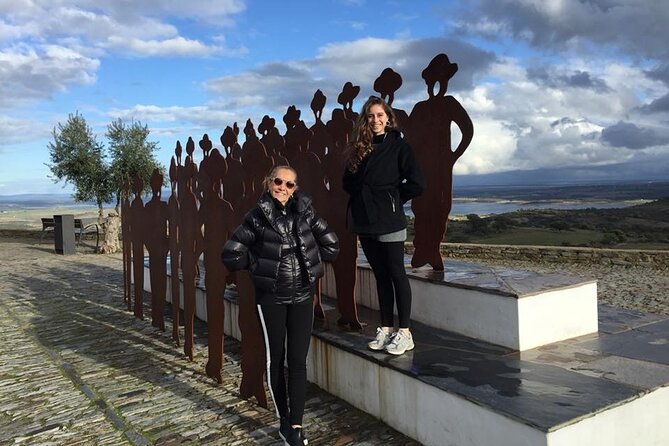
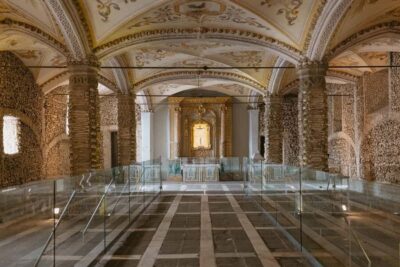
The Chapel of Bones, beside São Francisco, is Évora’s most memorable and unsettling sight. Its walls and pillars are lined with human bones and skulls, said to represent more than 5,000 monks. The purpose is not simple horror. The chapel asks you to think about mortality and the temporary nature of life.
A message at the entrance reinforces that theme: the bones are waiting here for you. It is stark, but the setting is religious and reflective. I would not choose this stop for very young children without considering how they react to death imagery.
The visit lasts about 30 minutes, and admission is not included. This is one of the paid stops where you should budget for the additional museum and monument tickets, listed at about €10 per person. Because the guide’s entrance is handled separately with guide identification, your own ticket remains the key extra cost.
Some people find the chapel the emotional high point of Évora. Others prefer the Roman Temple or cathedral. The private format lets you discuss it without being rushed into a large group’s next stop.
Praça do Giraldo and the everyday center
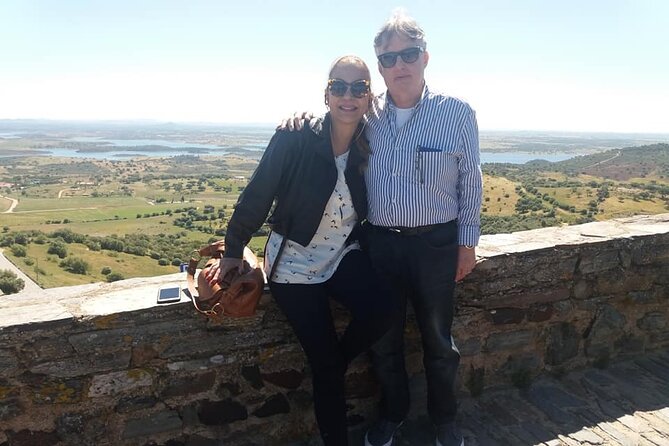
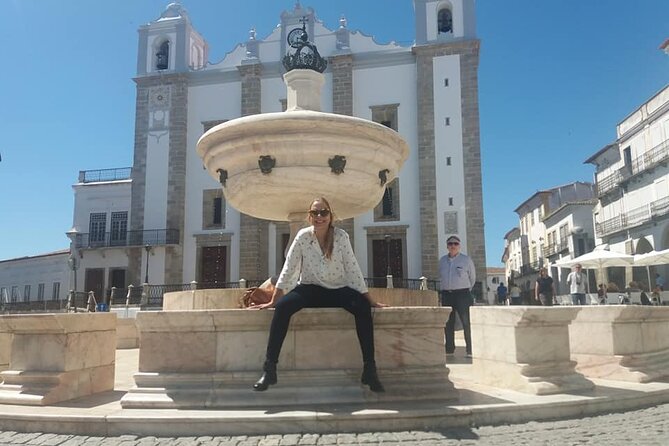
Praça do Giraldo is Évora’s main meeting place. Its present form dates from 1571 to 1573, and it honors Geraldo Geraldes, the figure credited with conquering Évora from the Moors in 1167.
The square is a useful place to get your bearings. Évora’s streets radiate from here, and you can pause for coffee, look at the surrounding façades, or begin a meal nearby. The formal stop is only about 15 minutes, but the square often becomes part of your free time.
This is also where the tour feels less like a monument checklist. You see how the old city functions as a living town. Shops, cafés, church towers, and local movement share the same space as the historic architecture.
Lunch is not included, but the guides can arrange or recommend a traditional Portuguese meal. Several tour experiences describe an excellent restaurant stop, while another group chose small bites instead of a sit-down lunch. That flexibility is useful. Tell your guide early if you want a proper meal, a quick break, or more time walking.
The Roman Temple and Diana’s Garden
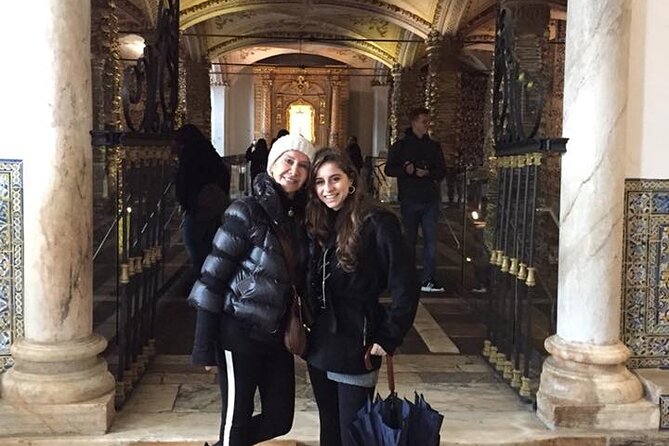
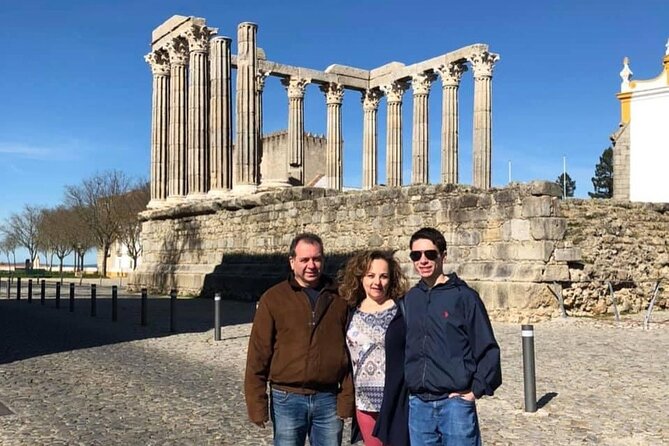
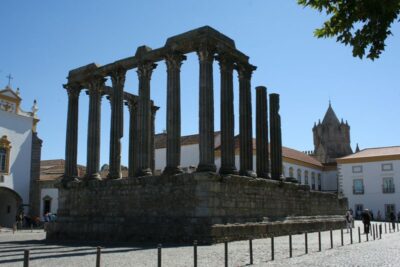
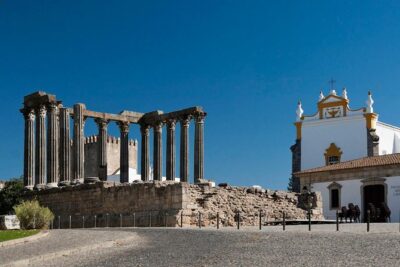
The Roman Temple of Évora, often called the Temple of Diana, is one of the city’s clearest reminders of its Roman past. Its surviving columns sit near the cathedral and provide an easy visual link between ancient Évora, the medieval center, and the later aqueduct.
The official stop lasts around 15 minutes and does not require an admission ticket. You will likely spend longer in the surrounding area because the temple is paired naturally with the cathedral, garden, and upper viewpoints.
Diana’s Garden lies beside the Roman Temple in Largo do Conde de Villa Flor. It is a pleasant place to finish or begin a walking route, with open space around the ruins and a pause from the narrow lanes. The garden is not a major standalone attraction, but it gives the tour a breather and a good setting for photographs.
The Roman stop is concise, so ask questions while you are there. A guide can make the columns more meaningful by explaining what they reveal about Évora’s place in the Roman world.
Évora Cathedral rewards the extra ticket
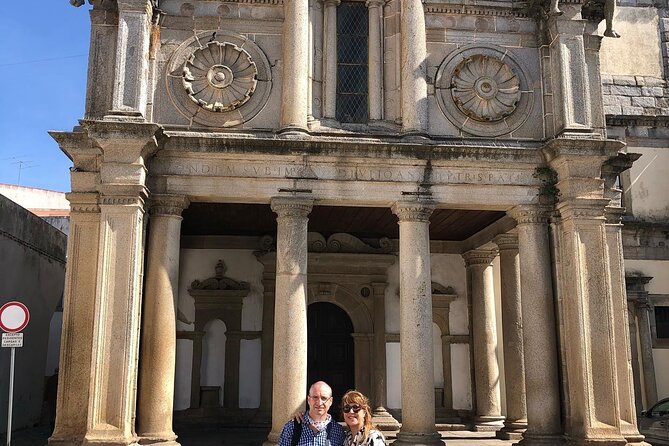
The Cathedral of Évora is the most imposing building on the route. Construction began in 1186, the cathedral was consecrated in 1204, and work continued until 1250. Built in granite, it shows the transition from Romanesque to Gothic design.
Two medieval towers frame the façade, with the southern tower serving as the bell tower. The entrance includes 14th-century apostle sculptures by Mestre Pêro. Inside, the scale and stonework give the building a firm, fortress-like presence.
The crossing tower is especially striking. Its lantern and stone-scaled spire date from the reign of Dinis and form one of the cathedral’s most recognizable features. Several tour experiences also highlight climbing to the top or roof area for views over Évora. Confirm exactly which access is open on your date, since the itinerary lists cathedral admission as extra and access conditions can vary.
The visit is scheduled for about 45 minutes. I would protect that time rather than treating the cathedral as a quick photo stop. If you enjoy churches, architecture, or city views, this is likely the most worthwhile paid admission of the day.
What the private format really gives you
Private does not mean every minute is custom-built from scratch. The day still follows a practical route from Lisbon to the cork facility and then through Évora’s main sights. But it does give you the power to make sensible adjustments.
You can spend longer at the cathedral, shorten a church visit, take lunch at your own pace, or skip an optional addition that would create too much driving. One useful piece of advice from the tour experiences is not to add distant megalithic sites or far-off towns unless you have extra time. Évora itself has enough to fill the day.
Guides João, Anastasiya, and other members of the team are described as punctual, friendly, and able to explain Portuguese history in clear language. João is noted for speaking four languages fluently, while Anastasiya is praised for patience, personal attention, and help with photographs. These details matter because the drive is long. A good guide turns the road time into part of the experience by explaining the places you pass.
The vehicle is air-conditioned, and pickup and drop-off are included. That is especially useful in hot weather or after a full day on foot. The tour is offered in English, and most people can participate, though the route includes walking through an old city and time in historic buildings.
Price, timing, and who gets the best value
At $169.31 per person, the tour makes the most sense for you if you are traveling with a partner, family, or small private group and want transport handled from start to finish. A self-guided train or bus trip could reduce the cost, but it would not provide the same door-to-door service or on-site explanation.
The nine-hour schedule is full. The drive from Lisbon takes about an hour and a half each way, leaving roughly six hours for the cork facility, Évora’s sights, lunch, and walking. That is enough for the main highlights, but not enough for every museum, shop, and church at a leisurely pace.
Plan for extra money for entrance tickets, listed at approximately €10 per person, and for lunch. Bring water, comfortable shoes, and a little flexibility. The experience is booked an average of 57 days ahead, so popular dates may need advance planning.
Free cancellation is available up to 24 hours before the start time for a full refund. Changes or cancellations inside that window are not accepted for a refund, and the experience may be rescheduled or refunded if its minimum number is not met.
Should you book the Évora and Alentejo tour?
I would book it if you want Évora without renting a car, prefer a private guide, and like the idea of combining monuments with a local industry. The cork facility is the unusual ingredient, and it gives the day more substance than a simple Roman ruins and church tour.
I would hesitate only if you dislike long road days or want a slow, independent stay in Évora. In that case, an overnight in the city would let you explore after the day visitors leave. For a first visit from Lisbon, though, this tour offers a well-balanced introduction, with the Chapel of Bones, cathedral, Roman Temple, aqueduct, medieval streets, and a memorable look at how Portugal’s cork industry works.
FAQ
How long is the Évora and Alentejo private tour?
The tour lasts approximately nine hours and begins at about 8:30 a.m.
Where can pickup and drop-off take place?
Pickup and drop-off are available at your hotel, apartment, or Lisbon cruise port.
Is transportation included?
Yes. The tour includes private transportation in an air-conditioned vehicle, along with WiFi on board.
Are entrance tickets included?
No. Entrance fees are not included. Museum and monument tickets are listed at approximately €10 per person.
Is lunch included?
No. Lunch is not included in the tour price.
What is the cancellation policy?
You can cancel up to 24 hours before the experience starts for a full refund. Cancellations or changes made less than 24 hours before the start time are not accepted for a refund.
New around Lisbon
- Arrábida, Setúbal, Sesimbra, Olive with wine tasting★ 5.0 · 75 reviews
- Lisbon: Sunset Sailing Boat Cruise with Wine★ 5.0 · 75 reviews
- Lisbon Half Day Private Tour★ 5.0 · 75 reviews
- Private Half Day Tour to Fatima from Lisbon★ 5.0 · 75 reviews
- Fátima, Nazaré and Óbidos Private Tour from Lisbon★ 5.0 · 76 reviews
- Central Lisbon 3-Hour Guided E-Bike Tour★ 4.8 · 76 reviews
- Lisbon Historic City Tour by Tuk-Tuk★ 5.0 · 76 reviews
- Sintra World Heritage and Cascais Village Private Deluxe Tour★ 5.0 · 76 reviews
Evora & Alentejo Day Trips, compared.
Évora and Monsaraz with Regional Wine Tasting from Lisbon
Read our review →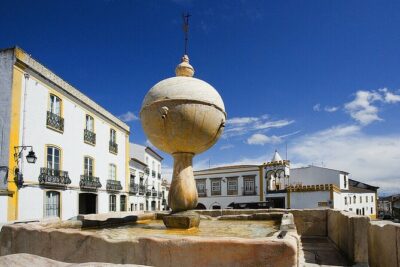
Private walking tour with tickets to main monuments
Read our review →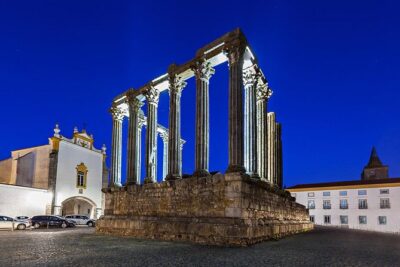
Private Day Tour With Guide to Évora and Monsaraz
Read our review →
From Lisbon to Alentejo: Évora and Megaliths Full-Day Tour
Read our review →
From Lisbon to Alentejo: Évora and Megaliths Full-Day Group Tour
Read our review →Browse the lists this tour appears in