
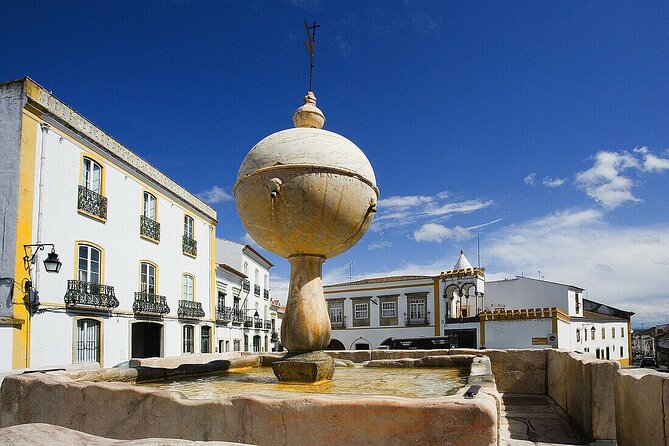
Reviewed · EVORA & ALENTEJO DAY TRIPS
Évora: Private walking tour with tickets to main monuments
Évora’s most striking surprise is how much Portuguese history fits inside one walk. In about two and a half hours, you pass from Roman columns to a Gothic cathedral, a chapel lined with human bones, royal ruins, and a Renaissance aqueduct. The private format lets your guide connect these places instead of treating them as isolated photo stops.
I like the included cathedral and Chapel of Bones tickets, since these are the two sights where admission matters most. I also like the personal format. Guides such as João, Paulo, John, and Elsa are named in the experience details, and the tour can adapt to your questions, pace, and interests.
The main drawback is the schedule. The walk covers many stops in a short time, and several visits last only five or ten minutes. If you want a slow look at every church, museum, and shop, you will need extra time in Évora after the tour.
Key points to know before you book
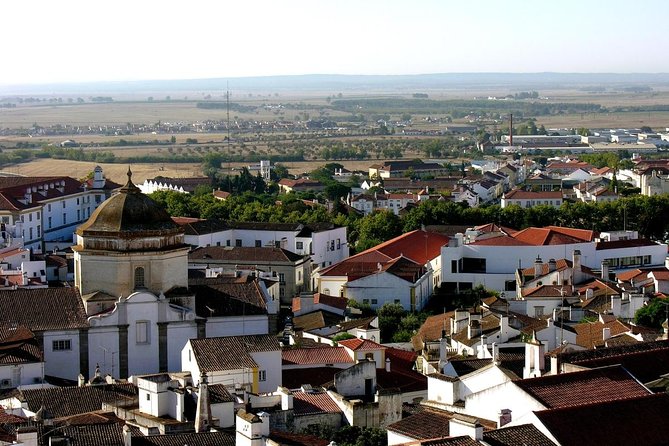
- The cathedral roof is included: See the Gothic interior, cloisters, and panoramic view over Évora.
- The Chapel of Bones is a central stop: Admission is included, and the guide explains its purpose, symbolism, and legends.
- This is a private walk: Only your group participates, so questions and pacing are easier to manage.
- You cover the city’s main eras: Roman, Visigothic, Muslim, medieval, Renaissance, royal, and Napoleonic-era history all enter the story.
- The route includes quieter corners: Pátio de São Miguel and Ruínas Fingidas add less familiar places to the standard sights.
- The meeting point is central: Begin at the Giraldo Square Fountain and finish back there.
Starting at Praça do Giraldo
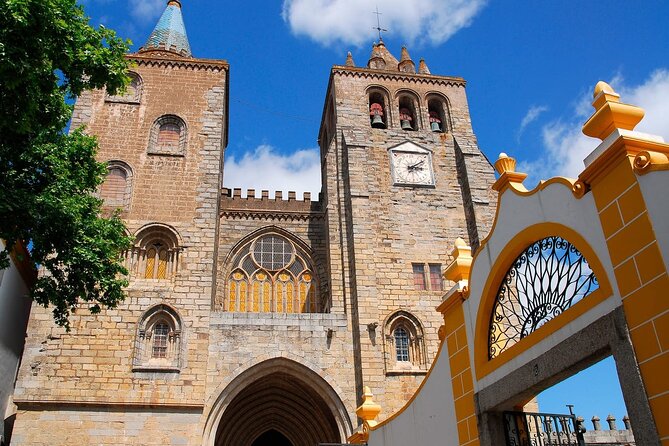
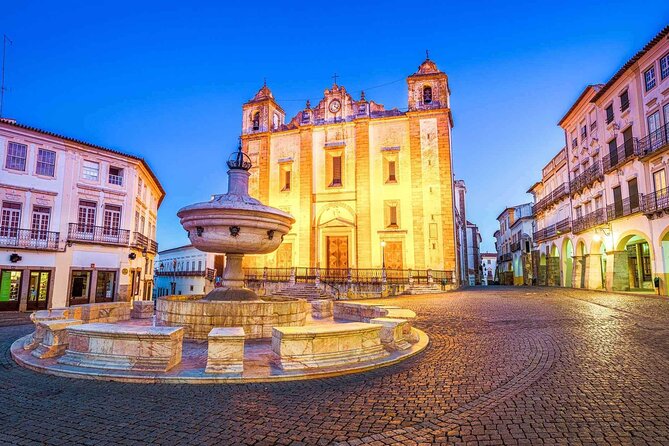
The tour begins at the Giraldo Square Fountain, a sensible place to get your bearings. Praça do Giraldo is Évora’s social and civic center, surrounded by arcades and historic buildings. It has served as a meeting place for economic, political, and public life for centuries.
This opening stop gives your guide room to explain Évora’s place in Portuguese history. The useful part is not just a list of dates. A good guide can show how events in Évora connect to Portugal’s overseas expansion, religious conflicts, royal power, and the wider history of Europe.
You also pause at the memorial to victims of the Portuguese Inquisition. This is a sober moment, and it gives the square another layer. Public executions took place here, including executions connected with Évora’s Inquisition court, described as the deadliest of Portugal’s four courts.
The subject is difficult, but it matters. Évora is not only a pretty Alentejo town of white walls and stone streets. Its past includes intolerance, persecution, and political decline. That balance makes the tour more useful than a walk focused only on attractive façades.
A few other Setubal District half-days worth a look
- Évora: Private walking tour, By Local Guide
★ 5.0 · 87 reviews - Évora and Megaliths Full-Day Tour from Lisbon
★ 4.7 · 456 reviews - From Lisbon: Évora and Monsaraz Day Tour with Wine Tasting
★ 4.8 · 279 reviews
Local shops and Alentejo craft traditions
The route passes along a traditional shopping street where you can see products tied to the Alentejo region. Cork objects, pottery, painted furniture, traditional rattles, and capotes, the area’s traditional cloaks, may appear in the shops.
This is a brief part of the walk, but it helps connect monuments with present-day Évora. Cork is especially important to Portugal, and a guide can explain why it appears so often in local products. If you plan to buy a souvenir, this is a better place to look than a generic airport shop.
The tour is conducted in English. The listed experience accepts mobile tickets, and confirmation is provided at booking. Bring comfortable shoes and expect regular walking over historic streets. A moderate level of fitness is recommended.
Entering Évora Cathedral and climbing to the roof
The Sé Catedral de Évora is one of the walk’s major attractions. It is described as Portugal’s largest Gothic cathedral, with design links to Notre-Dame in Paris. The visit includes the cathedral, cloisters, and roof.
The roof is the prize here. From above, you get a broad view across Évora, making it easier to understand the compact old center and the city’s position in the Alentejo. This is also one of the best moments to orient yourself after hearing about Évora’s walls and long development.
The cathedral itself brings together religious art, Gothic construction, and layers of older belief. The tour description points to references to earlier pagan cults, an intriguing detail that can lead to a more thoughtful conversation about how Christian buildings absorbed or reinterpreted older traditions.
You have about 30 minutes at the cathedral. That is enough for a well-led visit, but not enough for an exhaustive examination of every chapel and artwork. Ask your guide which details deserve your attention first. The included entry saves you from arranging separate admission and keeps the route moving.
The Roman Temple and Évora’s ancient foundations
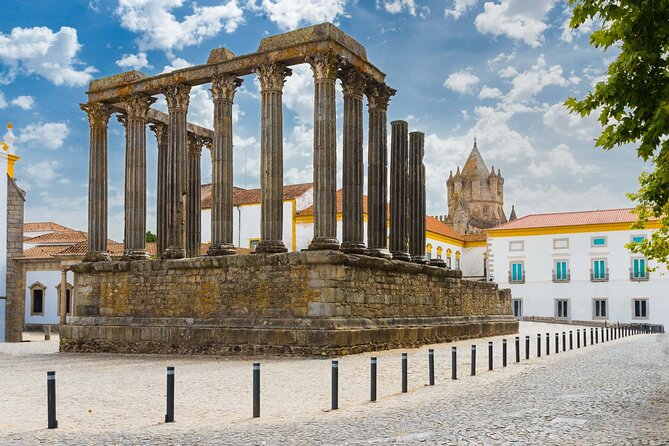
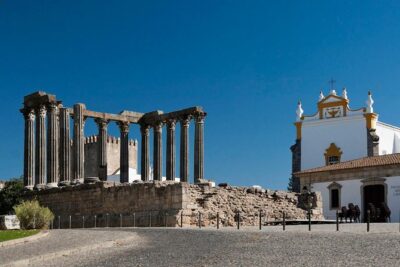
The Roman Temple of Évora, often called the Temple of Diana, gives the city its most recognizable ancient monument. Its columns have survived for roughly two millennia and recall the power of the Roman Empire in this part of Iberia.
Your guide explains the temple’s place in the ancient city, which was associated with Julius Caesar. The stop lasts about ten minutes and is outdoors, so you get a quick but useful explanation rather than an extended archaeological visit.
The temple is especially effective after the cathedral. Within a short walk, you see how Évora changed from a Roman center to a Christian and royal city. The contrast is one of the pleasures of this tour. You do not need to be an archaeology specialist to appreciate the scale and age of the remains.
More walking tours around Setubal District:
- Lisbon: History, Stories and Lifestyle Walking Tour
★ 4.8 · 10,902 reviews - Best of Lisbon Small-Group Guided Walking Tour
★ 5.0 · 4,869 reviews - Lisbon: Food and Wine Small Group Walking Tour
★ 4.9 · 4,082 reviews - Porto Walking Tour, Lello Bookshop, River Cruise and Cable Car
★ 5.0 · 3,354 reviews
Pátio de São Miguel and the city’s royal past
Pátio de São Miguel is one of the more unusual stops because it sits somewhat out of the main tourist flow. It was once a fortified area and a residence for the city governor. Portuguese kings also used it when staying in Évora.
This corner introduces the military and political side of the city. It is also linked with the Knights of Évora, whose later development led to the Order of Avis. That order helped bring about Portugal’s second royal dynasty, a major turning point in the country’s story.
For visitors who enjoy art, architecture, and political history, this may be one of the walk’s best surprises. The five or ten minutes allowed here will give you the outline. You may want to return later if the setting catches your interest.
The route also passes a 16th-century fountain associated with Mannerist art. It was inaugurated in 1556 during the period of Cardinal D. Henrique, a powerful patron of Évora and the last king of the Avis dynasty. The fountain shows how public works could signal progress and authority, not merely provide water.
Renaissance Évora at Igreja da Graça
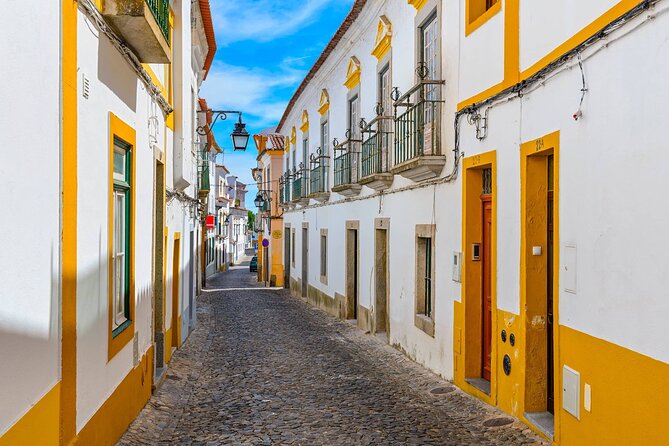
Igreja da Graça is presented as a major example of Portuguese Renaissance architecture, with Mannerist elements. Its façade carries symbolic details and the famous figures known as the boys of Graça.
This is a short stop, but it rewards a guide who can explain what you are seeing. Renaissance façades often look simple at first glance, yet their figures and arrangements carry political, religious, or moral messages. Here, the guide brings out the stories tied to the church and its former hermitage.
The church helps explain why Évora is so important for architecture. The city is not built around one famous monument alone. Its identity comes from the way Roman remains, medieval streets, religious buildings, royal spaces, and Renaissance design occupy the same walkable center.
The Chapel of Bones and the difficult side of devotion
The Capela dos Ossos is the most emotionally charged stop. Its walls are covered with real human bones belonging to thousands of people from Évora. The chapel was built in the 17th century and is meant to confront visitors with mortality.
Some people find it macabre. Others find it reflective and strangely calm. Your guide explains the chapel’s purpose, legends, and hidden details, which can make the visit feel less like a shock attraction and more like an expression of religious thought in its period.
Admission is included, and you have about 30 minutes here. That is generous compared with the shorter exterior stops. Take your time and notice how the room is arranged, not just the bones themselves.
The Chapel of Bones is not suitable for every mood or every child, and the tour does not soften its subject. Still, it is one of the places that tends to stay with you. It shows a side of Portuguese culture that is serious, direct, and unlike the polished palace-and-church circuit found elsewhere in Europe.
Igreja de São Francisco and the royal palace remains
Next comes Igreja de São Francisco, once known in the 16th century as the golden convent. The current church was built over an older 14th-century Franciscan foundation and became an important royal setting.
The church is linked with royal weddings and baptisms that affected Portugal’s future. That connection gives the building more weight than its architecture alone. Your guide uses the site to explain how religion, monarchy, and public ceremony worked together.
The adjoining remains of the old royal palace include the Ladies’ Gallery, described as the most romantic surviving part of the 16th-century complex. You have only about five minutes at the palace section, so think of it as an introduction rather than a full palace visit.
The short stop at Ruínas Fingidas adds a lighter note. These romantic ruins were assembled from elements of an older 16th-century palace and reflect the taste for poetic ruins that became popular in the late 19th century. It is a good photo setting and a reminder that historic-looking spaces are not always ancient in their present form.
Walking beside Évora’s defensive walls
The city walls are easy to overlook if you focus only on churches and squares. The tour points out several layers of defense: Roman walls from the 3rd and 4th centuries, later use by Visigothic and Muslim rulers, medieval walls from the 14th century, and bastioned structures from the 17th century.
The fortifications were strengthened again in the early 19th century during the period of the Napoleonic invasions. That long sequence makes the walls a compact lesson in military change. You can see how a city kept adapting its defenses as weapons, rulers, and threats changed.
The walls also help explain the shape of Évora’s old center. Inside them, the distances between major sights are manageable on foot. Outside them, the city opens into a broader modern setting. This is why a walking tour works so well here.
The Silver Water Aqueduct
The final major sight is the Aqueduto da Água de Prata, or Silver Water Aqueduct. Opened in 1537, it extends for about 18 kilometers and is often regarded as one of Portugal’s most important Renaissance civil works.
Its arches are particularly memorable because houses were built into and around them. The result is practical engineering mixed with urban beauty. Instead of seeing an aqueduct isolated in the countryside, you see one woven into the city itself.
The stop lasts about five minutes, enough to understand its purpose and architectural effect. If you enjoy public works, water systems, and city planning, note where the aqueduct disappears into the built environment. This is one place where the guide’s explanation adds real value.
The tour returns to the meeting point at Giraldo Square. That makes it easy to continue exploring, find lunch, or revisit a sight that went by quickly.
What the private format really adds
A private tour costs about $105.26 per person, with group discounts available. That is not a bargain-basement walking tour price, but the value depends on how many people are in your party and how much you want from the guide.
You are paying for a private English-language guide, a route covering many of Évora’s key sights, and entry to the cathedral and Chapel of Bones. The largest benefit is flexibility. Guides including João, Paulo, John, and Elsa are described as friendly, clear, and easy to question, with some tailoring the walk around family interests or adding restaurant and onward travel suggestions.
Several guide profiles point to strong academic or local backgrounds. João is described as studying archaeology at the University of Évora, while Elsa is from Évora. Those details matter because Évora rewards context. A plaque or column rarely explains itself.
The private format also helps if your group includes different ages or interests. You can ask about architecture, Roman history, Portuguese monarchy, cork, wine, or local food without waiting for a large group to move along.
The tradeoff is that a private tour is not automatically the best value for a solo visitor or a couple on a tight budget. If your group is small, compare the total cost with a shared walk and remember that the tickets are only included for two monuments.
Timing, pace, and practical planning
The advertised duration is about two hours and 30 minutes, though some guides may continue longer when questions and conversation take over. That flexibility has been a feature of the experience, but you should not count on extra time if you have a train, lunch reservation, or another timed visit.
The route includes many stops, with about 30 minutes at the cathedral and 30 minutes at the Chapel of Bones. Most other locations receive five to 15 minutes. You will see a great deal, but you will not have a long independent visit at every church or palace remnant.
Start at the Giraldo Square Fountain, Praça do Giraldo 7, and return there at the end. The tour is near public transportation, and confirmation arrives at booking. Free cancellation is available until 24 hours before the start time. Changes or cancellations inside that window are not accepted for a refund.
I would book this as an introduction to Évora, not as your entire Évora visit. Use the walk to understand the city’s shape and major stories, then spend another few hours returning to the cathedral, Chapel of Bones, shops, or aqueduct at your own pace.
Who will get the most from this Évora walk
This experience suits you if you want history delivered through places rather than through a long museum lecture. It is especially useful on a first visit, when you need a clear explanation of how Évora’s Roman, medieval, Muslim, religious, and royal periods fit together.
It also works well for families and small groups who prefer to ask questions freely. The gentle pace described by the guide details makes it less demanding than a rushed sightseeing circuit, though you still need moderate physical fitness and comfortable footwear.
Art and architecture fans will appreciate Igreja da Graça, the cathedral, the fountain, and the aqueduct. History fans will have plenty to discuss, from the Knights of Évora to the Inquisition and Napoleonic defenses.
You may want a different plan if you dislike religious monuments, human remains, or fast visits. The Chapel of Bones is central to the route, and the number of stops means you must accept a broad overview.
Should you book it?
Book this tour if you want a well-paced introduction to Évora with a private English-speaking guide and the city’s two most important paid sights included. The strongest reason to choose it is the combination of personal attention and historical range. Guides such as João, Paulo, John, and Elsa can turn a short walk into a connected story rather than a parade of names and dates.
I would be more cautious if you are trying to minimize cost or want extended time inside each monument. For most first-time visitors, though, the tour offers a practical way to get oriented, learn what makes Évora different, and decide where to spend the rest of your day.
FAQ
How long does the Évora private walking tour last?
The tour lasts approximately two hours and 30 minutes. Some tours may run longer if the guide continues answering questions, but you should plan around the advertised duration.
What is the meeting point?
The meeting point is the Giraldo Square Fountain at Praça do Giraldo 7, 7000-508 Évora, Portugal.
Where does the tour finish?
The activity ends back at the meeting point in Giraldo Square.
Is the tour private?
Yes. Only your group participates in the activity.
Is the tour offered in English?
Yes. English is the listed tour language.
Are cathedral tickets included?
Yes. The entry ticket includes the Cathedral of Évora, its cloisters, and the roof visit.
Is admission to the Chapel of Bones included?
Yes. Entry to the Chapel of Bones is included.
Are meals included?
No. Meals are not included in the tour price.
How much does the tour cost?
The listed price is $105.26 per person. Group discounts are available.
Can I cancel for a full refund?
Yes, if you cancel at least 24 hours before the experience begins. Cancellations or changes made less than 24 hours before the start time are not refunded.
New around Setubal District
- Lisbon: Kayaking and snorkeling in Sesimbra with photos!★ 5.0 · 74 reviews
- Portinho da Arrábida: Coasteering Boat Tour★ 4.9 · 78 reviews
- Arrábida: Guided Transparent Kayaking Tour★ 5.0 · 81 reviews
- Sesimbra Discovery by Kayak★ 5.0 · 84 reviews
- Évora: Private walking tour, By Local Guide★ 5.0 · 87 reviews
- Lisbon: Try Scuba Diving in Arrabida Marine Reserve with photos★ 5.0 · 99 reviews
- Arrábida Secret Beaches and Caves with Snorkeling Stop★ 5.0 · 109 reviews
- Melides: Horse Riding on the Beach with Wine Tasting★ 4.3 · 117 reviews
Evora & Alentejo Day Trips, compared.

Évora and Monsaraz with Regional Wine Tasting from Lisbon
Read our review →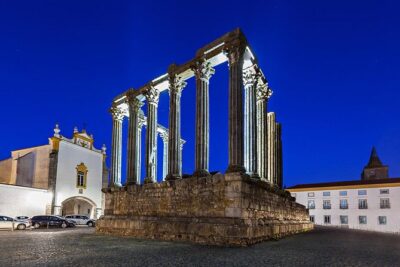
Private Day Tour With Guide to Évora and Monsaraz
Read our review →
From Lisbon to Alentejo: Évora and Megaliths Full-Day Tour
Read our review →

From Lisbon to Alentejo: Évora and Megaliths Full-Day Group Tour
Read our review →Browse the lists this tour appears in