
Reviewed · LISBON TOURS
Lisbon Hills Red Tram by Tram 28 route
Lisbon’s famous Tram 28 route is a fine way to see the city’s steep old quarters without spending your first morning climbing hills. This red tourist tram follows the same general route that draws crowds to the ordinary yellow 28E, but you get a seat, earphones, and recorded commentary.
I like two things here: the broad city overview and the practical 24-hour transport access that comes with the ticket. You can see Baixa, Chiado, Bairro Alto, and Alfama in one short ride, then use the funiculars and public trams later. The main concern is reliability. Road closures, blocked tracks, crowds, and unclear boarding directions have sometimes shortened or disrupted the ride.
Key points to know before booking
- The route covers Lisbon’s classic old quarters: You pass through Baixa, Chiado, Bairro Alto, and Alfama, including the cathedral and St. George’s Castle.
- Your ticket lasts 24 hours for included transport: After redeeming the voucher, you can use public trams, the funiculars, and the Santa Justa Lift during the validity period.
- The ride itself takes about one hour: Treat it mainly as a scenic circuit, not as a full-day hop-on, hop-off bus service.
- The red tram can be easier than public Tram 28: You avoid the ordinary tram’s standing-room crush and receive an audio guide through earphones.
- Board at Praça do Comércio near the arch: The voucher must be redeemed on board, but check current instructions with Yellow Bus because road works have caused temporary changes.
- The value depends on what you use afterward: At $30.10 per person, the ride alone is costly compared with ordinary public transport, but the extra 24-hour access may improve the deal.
Starting beside the Tagus at Praça do Comércio
The experience begins at Praça do Comércio, Lisbon’s grand waterfront square. Its wide stone expanse faces the Tagus River, with restaurants and bars around the edges and the monumental Rua Augusta Arch marking the entrance toward central Baixa.
This is a sensible meeting point because it puts you in the middle of Lisbon’s rebuilt downtown. Arrive with time to spare and look for the red tourist tram near the arch, not simply any yellow public tram. That distinction matters. Lisbon’s ordinary yellow trams use this part of the city too, and the two services can look confusingly related.
The supplied meeting information places the start at Praça do Comércio, near the arch, with departures from 10:00 a.m. to 6:00 p.m. every 30 minutes. Some operating details have varied, with notices and past experiences referring to different stops or delays, so I would check the current departure point with Yellow Bus before setting out.
Your voucher must be redeemed on board the tram. Keep it easy to reach on your phone or in printed form, and make sure the barcode can be read. A damaged or unclear voucher has caused avoidable trouble at the kiosk and boarding point.
A few other Lisbon half-days worth a look
- Lisbon City Center Tour – The Unmissable Lisbon
★ 5.0 · 22,234 reviews - Lisbon: Sintra, Pena, Regaleira, Cabo da Roca & Cascais
★ 4.7 · 19,656 reviews - Lisbon: Jerónimos Monastery Entrance Ticket
★ 4.1 · 14,164 reviews
What the red tram adds to Lisbon’s famous Tram 28 ride

The ordinary 28E tram is public transport. It is inexpensive and authentic, but it is also used by local residents and can be packed. You may need to stand, wait for the next car, or leave space for people getting on and off.
The red Hills Tram offers a more visitor-focused version of the same old-city experience. The tour has a listed maximum of 24 people, and several practical advantages come with that setup: a reserved place on the tour tram, an audio guide, and less uncertainty about squeezing into a public car.
I would not call the service a guaranteed fast-track ride. Buying in advance does not necessarily give you better seating or priority boarding, and the vehicle still faces Lisbon traffic. A broken-down car, an ambulance, road works, or a badly parked vehicle can stop any tram on the route.
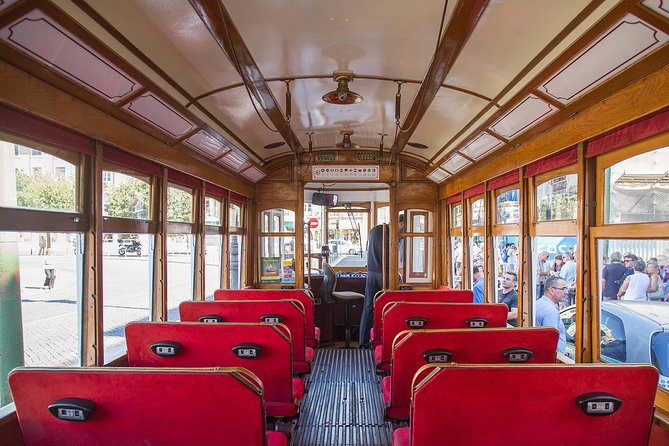
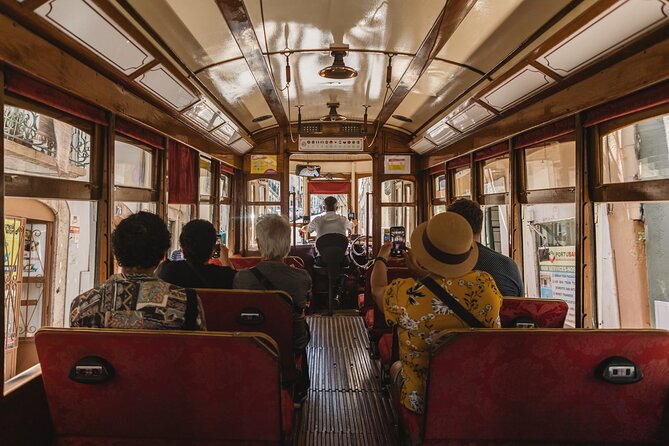
Inside, choose the left side when boarding if you want the best chance of a clear view. You receive earphones for the recorded commentary, and the narration covers local history and culture. The audio is one of the strongest parts of the package, though it may not run continuously through every stretch of the route.
Baixa and the city rebuilt after the 1755 earthquake

From Praça do Comércio, the tram heads into Baixa, the 18th-century downtown area rebuilt after the devastating 1755 earthquake. This part of Lisbon feels more orderly than the old hills, with broad streets, large squares, and a clear grid leading inland from the river.
The contrast is useful. You begin in open space beside the Tagus, then move through the planned center before the tram starts its climb. A stop described as the XII Century Monument adds a historic marker to the route, while the larger squares offer some of the easiest views from the tram.
This is not a walking tour, so you will not stop for a detailed look at each monument. Think of Baixa as your visual introduction to Lisbon’s changing city plan. The ride shows how quickly the city shifts from open, formal streets to tight lanes and sharp grades.
That change is one reason the tram is worthwhile early in a visit. I can use the overview to mark places I want to revisit on foot, rather than spending a full day trying to understand the city’s layout while tired from uphill walking.
Chiado and Bairro Alto, where Lisbon’s city life changes character
The tram climbs toward Chiado and Bairro Alto, two of the city’s best-known central quarters. Chiado is associated with cafés, museums, shops, and old meeting places for artists, journalists, and poets. Bairro Alto has a denser network of narrow streets and is known for its nightlife, small restaurants, and traditional urban atmosphere.
From a tram window, you get the shape of these neighborhoods more than a close look at their interiors. The route gives you a sense of how the streets rise and fold over the hills, while the commentary points out cultural landmarks along the way.
I especially like this section for first-time visitors who have limited time. You can see the relationship between the flat downtown and the hilltop districts in minutes, then return later to explore one quarter at a slower pace.
The drawback is that the tram cannot linger. If a café, museum, or viewpoint catches your eye, note its location and return on foot. The included map helps with this, and access to discounts in leisure, culture, dining, fado, and shopping may add modest value if you plan to use them.
Same coastline, a completely different day out:
- Lisbon: History, Stories and Lifestyle Walking Tour
★ 4.8 · 10,902 reviews - Lisbon: Sunset Boat Party Cruise with DJ and Open Bar
★ 4.5 · 10,378 reviews - Lisbon: Pena Palace, Sintra, Cabo da Roca, & Cascais Daytrip
★ 4.7 · 9,981 reviews - Lisbon: Oceanário de Lisboa Entrance Ticket
★ 4.6 · 9,943 reviews
The viewpoints and Tagus views are a real payoff

Lisbon’s hills create frequent openings toward the Tagus, and the tram passes several spots associated with broad city views. One itinerary stop is described as one of Lisbon’s most famous views of the river and city.
The exact quality of a view depends on traffic, weather, your side of the tram, and how quickly the vehicle moves through the street. Still, the ride gives you a useful first look at Lisbon’s tiled roofs, church towers, steep lanes, and river-facing slopes without asking you to climb between every viewpoint.
On a clear day, wide squares and flowering jacaranda trees can make this portion especially pleasant. In rain, the covered tram becomes practical rather than merely scenic. Bring patience, though. A tram ride is not a photo stop, and reflections or passengers may get in the way of a perfect picture.
For the best experience, sit where you have a side view rather than focusing only on the front. Keep your phone ready, but listen to the audio too. The route moves through narrow streets quickly, and the commentary can help explain what you are seeing before the next turn.
Alfama, the oldest quarter and the heart of the route
The tram’s most memorable stretch is Alfama. This is Lisbon’s oldest quarter, with steep lanes, tight corners, viewpoints, and buildings shaped by Roman and Arab influences. The route heads through the area associated with fado, the Portuguese musical tradition often linked with longing, loss, and life in the old neighborhoods.
You pass Lisbon Cathedral, dating from the 12th century, and continue toward the area around St. George’s Castle. These are major landmarks, but the tram’s value here is also sensory: the close walls, sharp bends, decorated squares, and sudden glimpses across the city.
This is where the red tram has a clear advantage over a walking-only introduction for anyone concerned about hills. You still see the steep streets, but you do not have to conquer them all at once. The ride can also help you decide if you want to return to the cathedral, castle, or a particular viewpoint.
Do not assume you can simply hop off at the castle and reboard whenever you like. Although the ticket includes 24-hour access to transport, the small tourist trams may fill before the next one arrives. The service operates at roughly 30-minute intervals, and getting back on can depend on available seats.
For that reason, I would stay aboard for the complete circuit on your first ride. Use the tour as an orientation loop. Then return independently to Alfama with the public transport access or on foot when you can give the quarter more time.
One hour on board, plus 24-hour transport access
The advertised tram circuit lasts about one hour. That makes it easy to fit into a first day, especially before a museum visit or an evening fado booking. It is also short enough that you do not need to build your entire schedule around it.
The bigger feature is the ticket’s 24-hour validity for public trams, funiculars, and the Santa Justa Lift. These additions matter in Lisbon, where the hills can make short distances surprisingly tiring. You can use the tram tour to get oriented, then use the included transport to reduce some uphill and downhill walking.
Read the wording carefully, however. The guided red tram ride itself is not a 24-hour ride. It is a roughly one-hour circuit. Some booking descriptions have led people to expect a conventional hop-on, hop-off product, and that expectation has caused frustration.
The safest plan is simple: stay on the red tram for the circuit, then use the public network separately. Do not build a tight connection around a precise finish time, especially during road works, city events, or heavy traffic.
Audio commentary, comfort, and what you actually see

Earphones are included, and the audio guide is available in English. It provides historical and cultural information as the tram passes through the neighborhoods, which makes the ride more useful than a silent circuit.
The commentary may be uneven in places. Some stretches have little or no narration, and the route can repeat part of its path on the return. That is normal for a compact city circuit, but it means the experience is not a continuous lecture.
Comfort is one of the tour’s most praised qualities. You have a place to sit, and the enclosed vehicle is helpful in rain. You also avoid the uncertainty of a packed public Tram 28, where standing passengers can block the view.
The tram is not a private car. It shares Lisbon’s narrow streets and tracks with ordinary traffic, so delays are possible. A route may also be shortened or suspended because of road works. Check service updates before you leave, particularly if you are visiting Lisbon for only one day.
Is $30.10 a fair price?

At $30.10 per person, the red tram is expensive if you compare it with the cost of a single public tram ride. The price makes more sense if you value the seat, the recorded commentary, the map, and the added 24-hour access to public trams, funiculars, and the Santa Justa Lift.
For a family or group, the total rises quickly. I would compare the package with the transport you already plan to buy and ask how much you value comfort. If you are happy to wait for a public tram, stand, and navigate without narration, the red tram may not offer enough extra value.
If you have limited mobility, dislike steep hills, or want a quick first look at several quarters, the cost may be easier to justify. The tram covers a lot of ground in a short time and can save energy for museums, viewpoints, meals, and walking later.
The discounts for leisure and culture, food and drink, fado, and shopping may help, but only if you actually use them. I would not count them as savings before checking which businesses participate and whether the discount fits your plans.
Who should book the Lisbon Hills Red Tram?
I would recommend it most strongly to a first-time visitor with one or two days in Lisbon, especially someone who wants a city overview before choosing where to spend more time. It also suits anyone who wants to experience the old tram route without depending entirely on the crowded public service.
It is a good fit for people who prefer sitting to standing, want English commentary, or need a break from Lisbon’s hills. Families may appreciate the short duration and the novelty of the old-style tram, though the price can add up.
I would be more cautious if you are booking around a fixed schedule. Service interruptions have included delays, early endings, route problems, and complete cancellations. Lisbon’s tram tracks are vulnerable to traffic and road conditions, and the tour operator does not control every obstacle.
The experience also may disappoint you if you expect a classic hop-on, hop-off system with frequent vehicles and guaranteed reboarding. The most reliable way to use it is as a one-hour scenic loop, followed by separate use of the included public transport.
Booking, boarding, and cancellation details
The stated meeting point is Praça do Comércio, 1100-148 Lisbon, near the arch, and the activity finishes back there. Departures are listed every 30 minutes from 10:00 a.m. to 6:00 p.m., but check current information because road works can temporarily suspend or alter the service.
Confirmation is provided at booking. Service animals are allowed, pets are permitted in carriers, and the tour is near public transport. Most people can participate, and the group size is capped at 24.
Because boarding instructions have not always been clear, I would arrive early and ask a Yellow Bus representative to confirm the red Hills Tram departure and voucher process. Do not board a standard yellow public tram first and expect its driver to accept the tourist voucher. Redeem the voucher on the correct red tram.
Free cancellation is available up to 24 hours before the local start time. Cancellations made within 24 hours, along with late changes, are not refunded.
Should you book it?
Book the Lisbon Hills Red Tram if you want a comfortable, narrated introduction to Lisbon’s steep historic quarters and will use the 24-hour transport access afterward. Stay on board for the full circuit, sit on the left if possible, and treat the ride as an orientation rather than a flexible hop-on, hop-off service.
Skip it if your main goal is the cheapest possible Tram 28 experience, or if road closures would leave you little room for a disrupted day. At $30.10, the tour earns its price through comfort and convenience, not through the one-hour ride alone.
FAQ
Where does the Lisbon Hills Red Tram tour start?
The tour starts at Praça do Comércio, near the arch, in central Lisbon. The activity also ends back at the meeting point.
How long does the tram tour last?
The red tram circuit lasts approximately one hour.
What are the departure times?
Departures are listed from 10:00 a.m. to 6:00 p.m., every 30 minutes. Road works or other conditions can temporarily affect the service, so check for current updates.
Is the ticket valid after the one-hour tram ride?
Yes. The ticket provides 24-hour access to public trams, the funiculars, and the Santa Justa Lift after the voucher has been redeemed on board.
Is an audio guide included?
Yes. Earphones are included, and the audio guide is offered in English.
Can I cancel for a full refund?
You can cancel at least 24 hours before the experience start time for a full refund. Cancellations or changes made less than 24 hours before the start time are not accepted for a refund.
New around Lisbon
- Arrábida, Setúbal, Sesimbra, Olive with wine tasting★ 5.0 · 75 reviews
- Lisbon: Sunset Sailing Boat Cruise with Wine★ 5.0 · 75 reviews
- Lisbon Half Day Private Tour★ 5.0 · 75 reviews
- Private Half Day Tour to Fatima from Lisbon★ 5.0 · 75 reviews
- Fátima, Nazaré and Óbidos Private Tour from Lisbon★ 5.0 · 76 reviews
- Central Lisbon 3-Hour Guided E-Bike Tour★ 4.8 · 76 reviews
- Lisbon Historic City Tour by Tuk-Tuk★ 5.0 · 76 reviews
- Sintra World Heritage and Cascais Village Private Deluxe Tour★ 5.0 · 76 reviews
Lisbon Tours, compared.

Lisbon City Center Tour – The Unmissable Lisbon
Read our review →
Sintra, Pena, Regaleira, Cabo da Roca & Cascais
Read our review →


Sunset Boat Party Cruise with DJ and Open Bar
Read our review →
Pena Palace, Sintra, Cabo da Roca, & Cascais Daytrip
Read our review →