
Reviewed · 1-DAY TOURS
Best of Braga and Guimaraes Day Trip from Porto
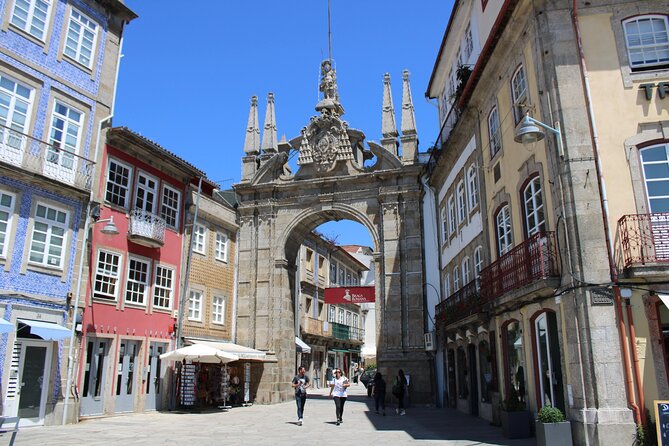
Portugal’s early story comes into focus on this day trip. At Bom Jesus, you see a spectacular Baroque stairway and a water-powered funicular; in Braga, you enter the country’s first cathedral; in Guimarães, you walk through the birthplace of Portugal and see the castle linked to its first king.
I like the strong mix of guided history and free time, since you get context without having every minute filled. I also like the comfortable air-conditioned minibus, which makes two towns north of Porto practical in one day, especially when the weather turns hot or wet.
The main drawback is the pace. Nine hours is a long day, and the group can reach 27 people. The tour may also run in English and Spanish together, so explanations can take longer and feel less complete than on a single-language outing.
Key points to know before booking
- Bom Jesus has one of Portugal’s great stairways: Seventeen landings display fountains, statues, and Baroque symbols beneath the hilltop church.
- Braga Cathedral predates Portugal: It was consecrated in 1089, before the country took its present form.
- Guimarães connects directly to Portugal’s beginnings: The castle is associated with Count Henry and the birth of Afonso Henriques.
- You get useful unstructured time: Braga includes about an hour for food and wandering, while Guimarães has a longer period to explore.
- The tour starts near São Bento Station: Meet at Calçada de Vandoma at 7:50 a.m., then return to the same meeting point.
- Castle access is limited: You should not expect full access to the walls, since that part is currently prohibited.
Why Braga and Guimarães make a good pair
Porto is a rewarding base, but northern Portugal becomes easier to understand once you head inland. Braga brings religious grandeur and centuries of church power. Guimarães brings medieval streets, royal beginnings, and a more intimate old-town feel.
I like the contrast. Braga’s Bom Jesus is set above the city, with formal steps and broad views. Its center then gives you a chance to eat and browse at your own speed. Guimarães feels more compact and historic, with granite buildings, arcades, balconies, and narrow lanes inside the old walls.
Doing both independently is possible, but a guided day saves you the work of sorting out transport and the historical links between each site. The tradeoff is that you follow a fixed schedule. If you want long museum visits or hours at a single café, this will feel too packed.
The tour costs $71.35 per person. That is a fair price if you value transport, a guide, and entry to Braga Cathedral and Guimarães Castle. Lunch and personal spending are extra, and hotel pickup is not included, so budget time and money for reaching the meeting point yourself.
A few other Porto half-days worth a look
- From Porto: Braga and Guimarães Full-Day Trip
★ 4.6 · 3,951 reviews - Day Trip from Porto to Santiago de Compostela and Valença
★ 5.0 · 883 reviews - From Porto: Arouca 516 and Paiva Walkways Guided Day Trip
★ 4.9 · 456 reviews
Starting early near São Bento Station
The meeting point is on Calçada de Vandoma, near São Bento Train Station, with departure set for 7:50 a.m. I would arrive early. A morning departure gives the tour enough time to cover both towns without turning the return to Porto into a late-night affair.
The vehicle is an air-conditioned minibus with a maximum capacity of 27 people. Some people praise the smooth driving and comfortable ride, while others find a full minibus less personal. The enclosed vehicle matters on a warm summer day, and it is equally useful when northern Portugal delivers one of its cold, rainy spells.
During the drive, your guide provides background on Portuguese history, national development, and cultural traditions. This is one of the tour’s real strengths. You are not simply being moved from one monument to the next, and the road time becomes part of the lesson.
Guides vary by departure. Names praised for warmth, clear explanations, and personal attention include Castro, Christian, José, Pedro, and Jorge Mendoza. Carlos and Manuel have also been noted for careful driving. You cannot select a particular guide from the information provided, but the standard is clearly shaped by the person leading the day.
Bom Jesus and the water-powered funicular
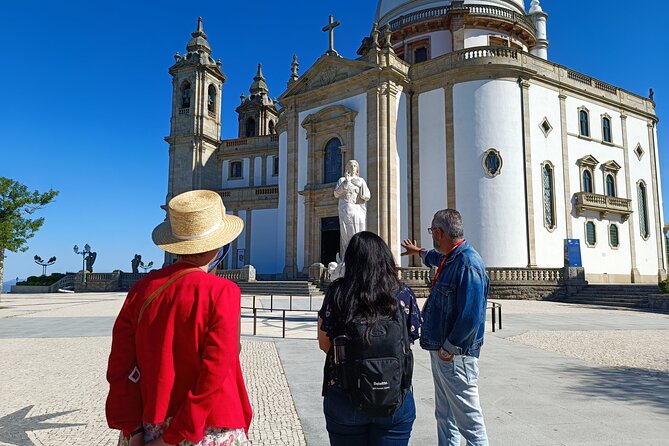
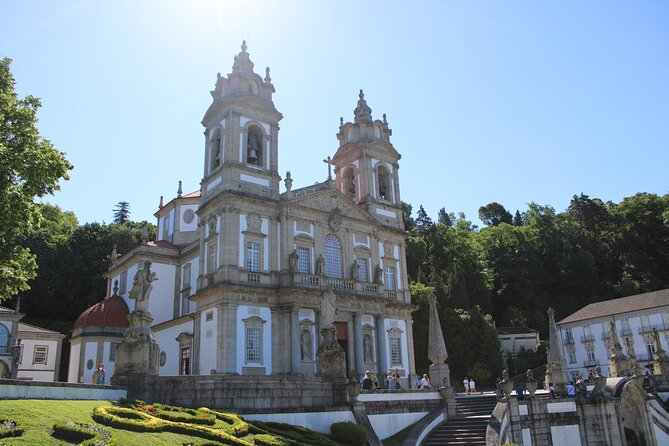
Bom Jesus do Monte is the visual high point of the morning. The sanctuary is famous for its religious meaning, but the setting and engineering are just as interesting. The church, designed by Carlos Amarante, uses an Italian-inspired neoclassical style that fits neatly into the northern Portuguese hillside.
From below, the staircase is the essential view. Its white church appears to sit at the top of an ornate granite climb, with landings arranged in a long symbolic sequence. You will see fountains, allegorical figures, and Baroque decoration tied to themes including the Stations of the Cross, the Five Senses, the Virtues, Moses receiving the Commandments, and the biblical figures connected with Jesus’ condemnation.
The stairway has 17 landings. That detail helps you read the monument as more than a pretty staircase. It was designed as a religious journey, with each level adding another layer of meaning.
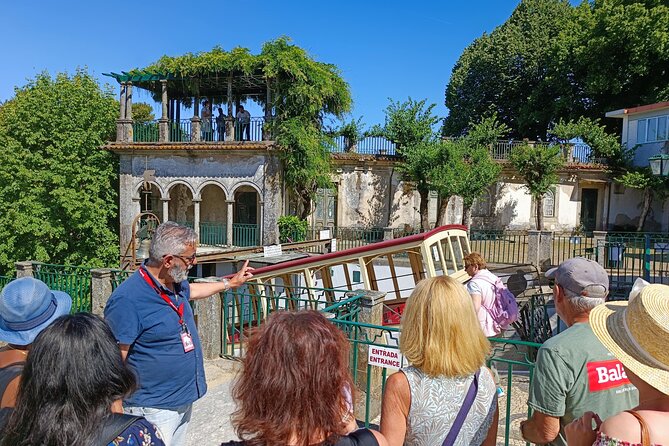
The funicular is a remarkable piece of 19th-century engineering. Installed in 1882, it was the first of its kind in Portugal and still uses water power to move along its 300-meter route in about three minutes. The stop lasts around 30 minutes, with admission to the sanctuary included.
That half hour is enough to appreciate the setting and hear the explanation, but it is not enough for a leisurely climb up and down the full staircase. If photographing every landing matters to you, you may wish you had more time. Still, the guide helps you notice details you could easily miss if you arrived only for the view.
Braga Cathedral and an hour to roam
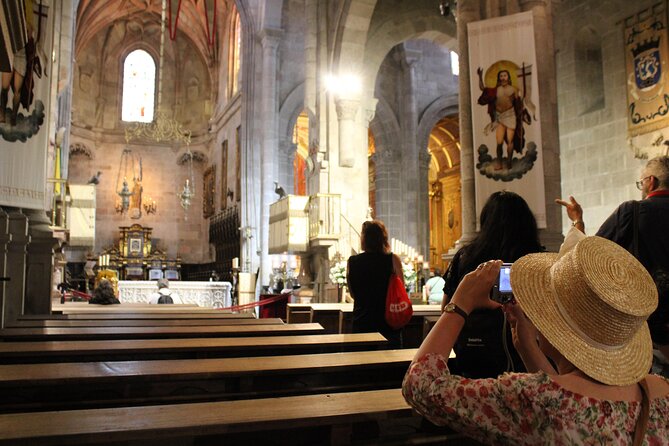
The next stop is Sé de Braga, Portugal’s first cathedral. Construction began at the end of the 11th century, and Bishop Pedro consecrated it to the Virgin Mary on August 28, 1089. That date places the building several decades before the formal founding of Portugal.
The cathedral also reflects the power of Braga as a religious center. It competed for influence with Santiago de Compostela, and the building remains one of the city’s major landmarks. Inside, the Chapel of Kings contains the tombs of Count Henry and Teresa, the parents of Afonso Henriques, Portugal’s first king.
You have about 30 minutes here, with admission included. That is a useful amount of time for a focused visit, though not a full study of every chapel and architectural detail. Listen closely to the guide, then use your own eyes. The significance of the cathedral is not only its age, but also its connection to the family that helped create Portugal.
Afterward, you get about an hour in Braga. This is a welcome change of rhythm. You can find lunch, walk the central streets, visit shops, or simply sit down after the morning’s sightseeing.
Lunch is not included, and no particular restaurant is guaranteed. Guides may suggest places, and one especially useful part of the experience is receiving local food advice. Keep an eye on the meeting time, since the next stop is Guimarães and the group cannot wait for late diners.
Same coastline, a completely different day out:
- The Unvanquished Tour in Porto City Center
★ 5.0 · 26,497 reviews - From Porto: Douro Valley w/ Boat Tour, Wine Tasting & Lunch
★ 4.7 · 19,061 reviews - Complete Douro Valley Wine Tour with Lunch, Wine Tastings and River Cruise
★ 5.0 · 12,920 reviews - Porto: Six Bridges Cruise
★ 4.2 · 11,680 reviews
Guimarães, the birthplace of Portugal
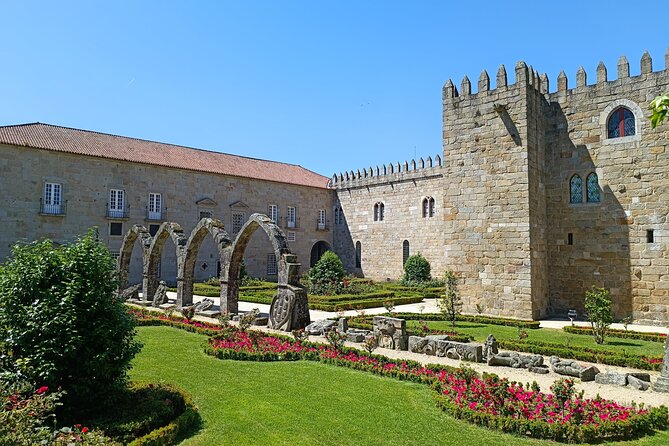
The short drive to Guimarães changes the mood. Braga feels like a major historic religious city, while Guimarães is smaller and more tightly framed by its old center.
Afonso Henriques, who became Portugal’s first king, was born here. That connection gives the town unusual weight in the national story. You are not just seeing an attractive medieval center; you are walking through a place tied to the formation of the country itself.
The schedule allows about two hours in Guimarães, including the castle, São Miguel do Castelo, and the historic center. That is enough to see the main sights and have some time for lunch or independent wandering, but you should expect a walking-heavy afternoon on uneven paving.
Guimarães Castle and the story of Count Henry
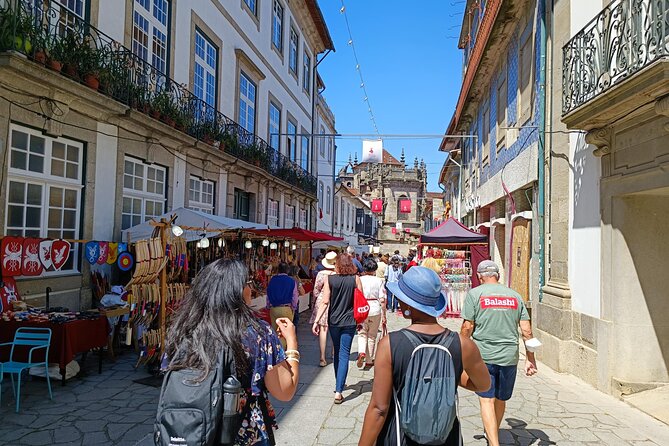
Guimarães Castle rises on Monte Largo, the broad hill where the early Portuguese nation began to take shape. Its first defensive structure was ordered around 968 by Mumadona, Countess of Galicia, to protect the local population from attacks by Vikings arriving from the north and Muslim forces raiding from the south.
Count Henry later ordered a larger and stronger construction after taking control of the Portucalense province. The castle we see today is shaped by that defensive purpose, with four corner towers and a square keep at the center.
Tradition places the residence of Count Henry against the inner northern wall and suggests that Afonso Henriques was born there. The birth story is not strictly documented, but it is central to the meaning of the site.
Entry is included, and the castle visit lasts about 30 minutes. There is an important limitation: access to the walls is currently prohibited, and access within the castle is limited. This is not a vast furnished fortress with rooms full of displays. You are mainly seeing a powerful shell and learning why the site matters.
Some people may find the castle underwhelming if they expect extensive interiors. I think it works best when paired with the guide’s explanation. The stones alone tell only part of the story; the political and military setting gives them purpose.
São Miguel do Castelo and a small Romanesque church
Just beside the castle is the Igreja de São Miguel do Castelo. The small Romanesque church was built in the 13th century, though tradition places its foundation in the 12th century and links it to Count Henry.
According to that tradition, Afonso Henriques was baptized here. The church is simple and spare, with little decoration and a modest scale that contrasts with the castle next door.
The stop lasts about 10 minutes. That is enough for a quick look, not a long architectural visit. Beneath the floor are the graves of warriors from the period when Portugal was being founded, adding a sober note to the site.
Walking through Guimarães old town
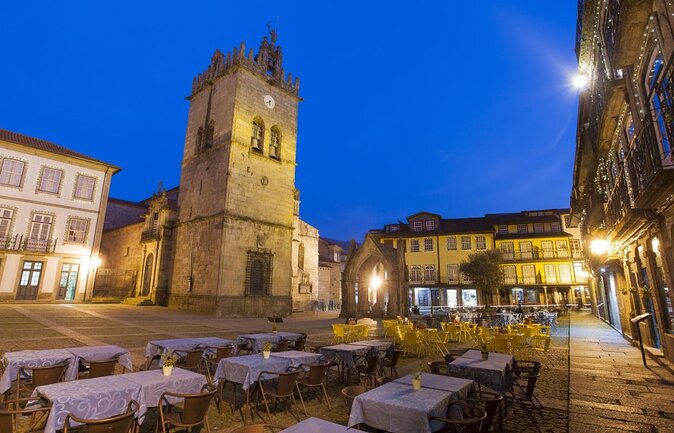
The historic center is where Guimarães earns its World Heritage status. The area inside the old walls has been restored with care, while keeping the features that make it feel old rather than newly manufactured.
You will walk past iron verandas, granite balconies, porticos, mansions, towers, cloisters, and arches that connect narrow streets. The paving is worn smooth in places, and the buildings give the center a close, almost stage-like feel.
Several historic houses and palaces help explain the town’s social past, including the Mota Prego house, Vila Flor Palace, and Toural Palace. You do not need to memorize every name. Simply notice how the homes, religious buildings, and public spaces fit together.
The guided walk lasts about 30 minutes, followed by free time within the broader Guimarães stop. This balance works well. A guide gives you the basic map and meaning, then you can choose a shop, café, side street, or square that catches your eye.
Guimarães is not a huge city, and some people may find the list of attractions short. I see that as part of its appeal. You can get a feel for the old center without spending the entire day crossing town.
The guide makes or breaks the day
This tour depends heavily on the guide. The strongest departures are led by someone who can connect monuments to the larger story, explain details during the drives, and keep the group moving without making the day feel mechanical.
Castro has been singled out for careful organization, attention to detail, and a warm way of addressing the group. Christian is praised for his pride in Portuguese history and for explaining both cities clearly. José is noted for answering unexpected questions and checking in with people during free time, while Pedro is praised for pacing the day well.
Those personal touches matter. On a full-day trip, a guide who notices when people are tired, clarifies meeting times, and offers practical food advice can make the difference between a pleasant outing and a tiring procession.
There is one clear concern. The tour may be conducted in two languages, even if you book the English option. A guide may speak first in English and then Spanish, or the reverse. That can reduce the amount of detail and leave less time for wandering. If a single-language tour is essential to you, confirm the arrangement before booking.
Weather, walking, and what to bring
Rain does not automatically stop the tour. The experience continues in poor weather, and several stops are outdoors. Bom Jesus steps, castle grounds, and Guimarães paving can all feel less comfortable in rain.
Bring waterproof shoes or shoes with a firm sole, a light rain layer, and an extra layer for the minibus. On a hot day, the air conditioning helps, but you will still be outside at the monuments. A small umbrella may help, though it can be awkward during a group walk.
The schedule includes sitting, guided walks, and free time. That mix is easier than nine straight hours on foot, but this is not a low-mobility sightseeing day. The information says most people can participate, yet the stairway and historic paving deserve consideration before you reserve.
Is the $71.35 price good value?
At $71.35, you are paying for convenience as much as admission. The price covers transport in an air-conditioned minibus, a professional destination guide, Bom Jesus Sanctuary, Braga Cathedral, Guimarães Castle, and the guided walk through a UNESCO-listed center.
The two included attraction entries help. So does the fact that you do not have to plan the route between Porto, Braga, and Guimarães. Add lunch and personal purchases, plus your own transport to the meeting point, and the final cost will be higher.
I would call it good value for a first visit to northern Portugal, especially if you are traveling alone or do not want to manage regional connections. If you are comfortable arranging transport and prefer to spend half a day in one town, a self-guided plan may give you more freedom.
The tour also includes access to a free Porto walking tour from the day after the excursion. It runs daily in English and Spanish at 9:30 a.m. and 4:30 p.m., departing from the Living Tours agency at Rua Mouzinho da Silveira 352. That extra can add value if you have time in Porto.
Who should book this day trip?
I would choose this tour if you want a clear introduction to Portugal’s northern origins, enjoy hearing historical context, and like having transport handled for you. It suits first-time visitors to Braga and Guimarães, solo visitors, couples, and families who want a full day outside Porto.
It is also a good choice for anyone who wants more than the familiar Porto sights. Braga’s religious monuments and Guimarães’ medieval center feel distinct from the city streets along the Douro.
I would hesitate if you dislike early starts, group schedules, bilingual explanations, or outdoor sightseeing in uncertain weather. I would also think twice if your main goal is to climb every step at Bom Jesus, explore every castle wall, or spend a long afternoon shopping in Guimarães.
Should you book the Braga and Guimarães trip?
Book it if you want two important northern Portuguese towns in one organized day, with strong historical commentary and enough free time to eat and wander. The best reason to go is the combination of Bom Jesus, Portugal’s first cathedral, and Guimarães’ links to Afonso Henriques.
Go with realistic expectations. This is a broad introduction, not a slow architectural study. The group may be large, the day may be bilingual, castle access is limited, and rain can make the walking harder.
For most visitors with only a few days in Porto, I think the $71.35 price is justified. You gain easy transport, included admissions, a useful overview of Portugal’s beginnings, and a chance to see places you might otherwise skip.
FAQ
Where does the tour start?
The tour starts at Calçada de Vandoma in Porto, near São Bento Train Station.
What time does the tour begin?
The scheduled start time is 7:50 a.m.
Where does the tour end?
The activity ends back at the original meeting point in Porto.
How long does the day trip last?
The tour lasts approximately nine hours. The exact duration can change because of local traffic, visit schedules, and other conditions.
Is transportation included?
Yes. Transportation is provided in a comfortable, air-conditioned minibus.
Are admission tickets included?
Yes. Admission to Braga Cathedral and Guimarães Castle is included, along with entrance to Bom Jesus Sanctuary.
Is lunch included?
No. Lunch and personal expenses are not included. You receive free time in Braga and Guimarães to find food.
Can the tour be bilingual?
Yes. Tours are usually conducted in one language, but a second language may be used. English is offered, and the tour can include English and Spanish together.
New around Porto
- Porto: City Bike Rental★ 4.6 · 75 reviews
- Fado Concert with Welcome Drink★ 5.0 · 75 reviews
- Boat Trip to Régua Through the Douro Valley with Breakfast and Lunch★ 4.5 · 76 reviews
- Porto City Tour Half Day – Private★ 5.0 · 77 reviews
- Port : Private Cruise in the Douro — 6 Bridges & Sunsets★ 5.0 · 78 reviews
- Porto Private Airport Departure Transfer★ 4.5 · 78 reviews
- Half-Day Walking Tour Tasting Local Food in Porto★ 5.0 · 78 reviews
- Douro Valley Small-Group Tour: 2 Wineries, Lunch, Optional Cruise★ 5.0 · 78 reviews
1-Day Tours, compared.
Sintra and Cascais Small-Group Day Trip from Lisbon
Read our review →
Three Cities in One Day: Porto, Nazare and Obidos from Lisbon
Read our review →
Day Trip from Porto to Santiago de Compostela and Valença
Read our review →
Fatima Batalha Nazare & Obidos Small Group Day Trip
Read our review →
Arrabida and Sesimbra Small-Group Day Trip from Lisbon with Wine Tasting
Read our review →Browse the lists this tour appears in