
Reviewed · SETUBAL DISTRICT TOURS
Coasteering at Portinho da Arrábida
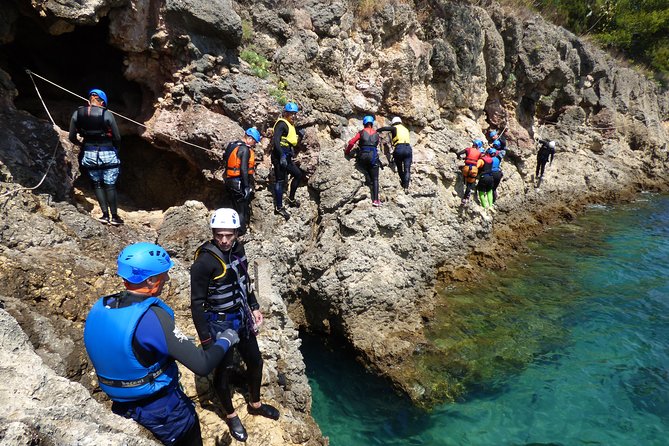
Portinho da Arrábida coasteering turns a beautiful stretch of Portugal’s coast into your playground. You move from rock to sea by cliff jumps, rappelling, swimming, and scrambling, with a cave visit and a final zip line adding extra spice. It is active, but the guides adjust the challenge when someone needs a lower jump or more time.
I like the mix of adventure and scenery, since you are not just walking to a viewpoint and taking a photo. I also like the careful, encouraging approach reported by participants, especially for nervous beginners and younger members of a family. The main consideration is fitness: some rocky sections require climbing, and the four-hour session is not a passive beach outing.
Key points to know before you book
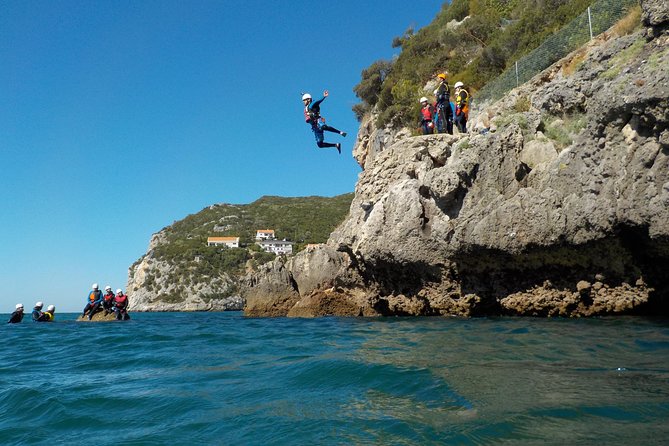
- Cliff jumps are optional in practice: Guides can direct nervous participants toward a lower jump and help them build confidence.
- The route mixes many activities: Expect swimming, rock climbing, rappelling, sliding, hiking, a cave visit, and a zip line.
- Arrábida provides the setting: The activity takes place around Portinho da Arrábida in Serra da Arrábida Natural Park.
- Safety equipment is supplied: You receive a 5mm thermal costume, helmet, harness, life jacket, and gloves.
- It suits active families: A family with teenagers aged 14, 16, and 18 completed it together and especially enjoyed the zip line.
- The cost covers more than instruction: At $84.69 per person, the package includes equipment, bottled water, energy bars, and snacks.
Why Portinho da Arrábida makes a good coasteering base
Coasteering works best where cliffs, ledges, small coves, and open water meet. Portinho da Arrábida gives you that combination in one compact outing, inside the Serra da Arrábida Natural Park in Portugal’s Setubal District.
The setting matters because the activity is not simply a sequence of manufactured obstacles. You use the coast itself. A ledge becomes a jump point, a rock face becomes a short climb, and a sea cave becomes part of the route. The result feels more connected to the place than a standard ropes course.
You should also expect the scenery to compete for your attention. Portinho da Arrábida is known for its striking coastal setting, but this outing asks you to experience it at water level. You may be looking up at the cliffs one moment and entering a cave or swimming beside rock walls the next.
The company calls the activity flying into water, which gives you a fair idea of its character. The jumps create the biggest rush, but coasteering is really a chain of smaller challenges. If you like variety, you will get more from this than from an outing built around one large jump.
A few other Setubal District half-days worth a look
- Setúbal: Dolphin Watching Tour
★ 4.8 · 801 reviews - Lisbon: Kayaking and Snorkeling Adventure
★ 4.9 · 538 reviews - Setúbal: Dolphin Watching Boat Tour
★ 4.8 · 423 reviews
What happens during the four-hour outing
The session lasts about four hours, including the different sections of the route. You begin at Rua do Portinho da Arrábida, in São Lourenço, and finish at the same meeting point, so you do not need to arrange a separate return transfer.
The exact order and timing of each activity can depend on conditions and the group. You should plan for a steady rotation between walking, climbing, swimming, and short technical sections rather than a long block devoted to one sport.
Your guides provide the equipment and explain how to use it. The supplied kit includes a 5mm thermal costume, helmet, harness, life jacket, and gloves. That is useful because coasteering exposes you to cool water, wet rocks, and repeated contact with the cliff. You do not need to assemble your own technical kit.
Safety instruction is especially important here. One account describes a younger participant who felt unsure about the higher jumps. A guide brought her to a lower jump, helped her work on the technique, and repeated the easier version before allowing her to consider a higher one. That is the sort of judgment you want in an activity where enthusiasm should never outrun control.
You should still arrive ready to take responsibility for your own comfort. Tell the guides early if you are nervous, tired, or unsure about a move. The supplied life jacket helps with water confidence, but it does not turn the activity into a relaxed swim.
Forte de Santa Maria da Arrábida begins the coastal story
Forte de Santa Maria da Arrábida is one of the named stops on the route. Here, the outing connects the coast’s natural features with a built landmark, giving the session a little more character than a pure action circuit.
The fort provides a sense of place as you move along the shore. You are not simply jumping from random rocks. The route links a recognized point in the Portinho da Arrábida area with the physical challenges around it.
Expect the fort stop to be part of an active progression rather than a long sightseeing visit. The supplied details do not promise a formal historical tour or extended time inside the building, so you should book this for the coasteering first and the fort second.
That distinction helps set expectations. If your main goal is to study military architecture, choose a dedicated heritage visit. If you want a scenic coastal route with a memorable landmark along the way, the fort adds useful variety.
Lapa de Santa Margarida adds a cave visit
Lapa de Santa Margarida is the second named stop. The cave visit is one of the more distinctive parts of the outing because it changes the mood from open water and exposed rock to a more enclosed setting.
Caves also make a coasteering route feel exploratory without requiring a long expedition. You may reach the cave after swimming or climbing along the coast, so the stop becomes part of the physical story of the day rather than an isolated attraction.
The information provided does not specify the cave’s exact size, lighting, or time spent inside. Keep that in mind when comparing this outing with a dedicated cave tour. Here, the cave is one element in a larger four-hour program that also includes jumps, a rappel, a slide, swimming, and hiking.
Still, it is a strong reason to choose this route over a simple cliff-jumping session. You get more changes of pace, and the cave visit gives the group a natural pause between more energetic sections.
Same coastline, a completely different day out:
- Sesimbra: Arrábida Dolphin and Whale Watching tour with biologist
★ 5.0 · 248 reviews - Observation of Dolphins and Whales with Marine Biologist in Arrábida
★ 5.0 · 224 reviews - Évora: Private walking tour with tickets to main monuments
★ 5.0 · 223 reviews - Setúbal: Dolphin-Watching Boat Tour
★ 4.8 · 213 reviews
The jumps are exciting, but you control the pace
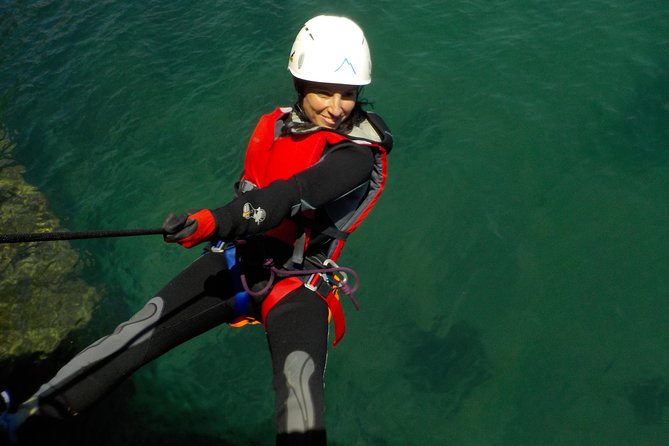
Cliff jumping is the headline feature, and it is easy to understand why. You climb to a ledge, listen to the guide’s instructions, and commit to the water below. The height creates the emotion, but the technique and timing matter more than bravado.
You should not feel pressured to take the highest option. The strongest safety detail from the available feedback is that a guide encouraged a nervous young participant while still keeping her on a lower jump until she had the technique down. That balance is reassuring for families and first-timers.
The jumps are also only one part of the activity. If you dislike heights, you may still enjoy the swimming, cave, hike, slide, and lower-level climbing sections. Tell the guides what concerns you, since the route appears to allow some adjustment within the group.
At the same time, do not book this expecting every challenge to be optional or effortless. You will be in the water and on uneven rock for much of the session. A willingness to get wet, climb, and follow instructions is essential.
Rappelling, rock climbing, and the final zip line
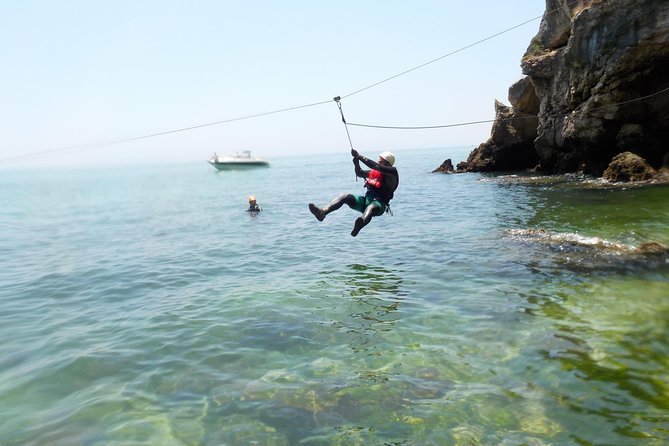
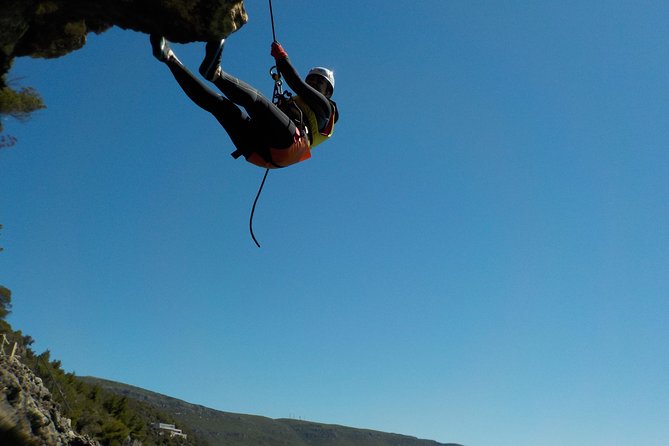
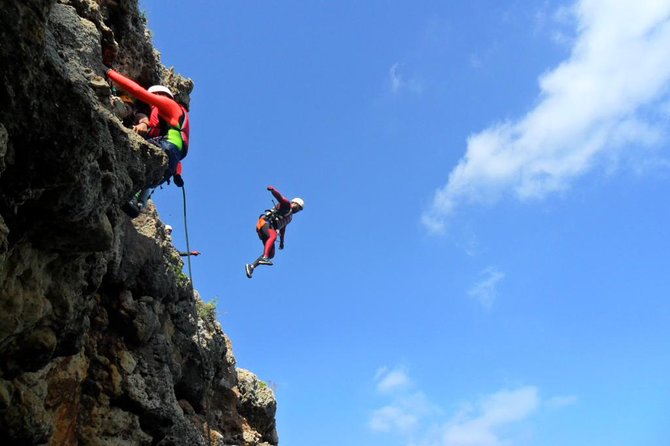
The harness and helmet come into their own during the climbing and rappel sections. Rappelling gives you a controlled way to descend rock, while short climbs ask you to use your hands and feet carefully on uneven surfaces.
You do not need to arrive as an expert climber. The guides assist participants through the rocky areas, and one account specifically notes that the climbing felt manageable with help. Even so, basic fitness will make the day more comfortable.
The final zip line is a memorable finish for families and anyone who enjoys a clear payoff at the end of a long activity. It adds a different sensation from the jumps, since you move through the air rather than dropping directly into the water.
You should treat the zip line as a highlight, not a guarantee of a particular height or length. The supplied information confirms that participants enjoyed it, but does not give technical specifications. The value is in the change of pace and the sense of completion.
Swimming and hiking keep the route varied
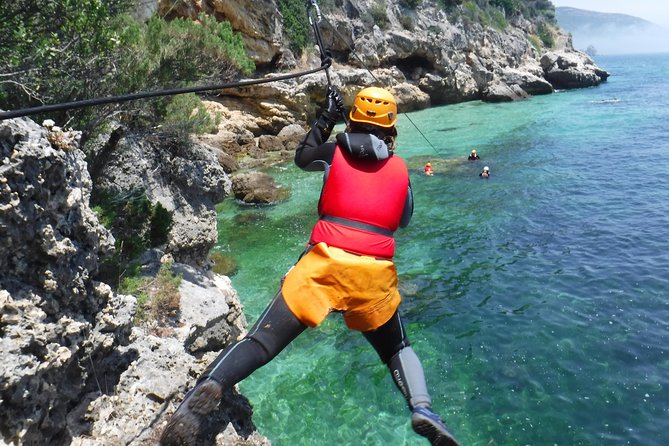
Swimming links the coastal sections and gives your body a break from climbing, though it is not necessarily easy recovery. You may be wearing a thermal costume, life jacket, helmet, and gloves, so the water sections are active rather than a leisurely float.
The 5mm costume is a practical inclusion. It helps with comfort during a session that combines repeated water entry with time out of the water. You should still expect to feel cool at times, since the costume supports warmth but does not remove the sensation of cold water or wet rock.
Hiking gives the group a chance to move between features. These walks may be short, but uneven coastal ground can still demand attention. Wear suitable footwear if the operator provides guidance about it, and ask about shoe rentals if that is relevant to you. One participant reported a small issue with shoe rental, so it is worth confirming the arrangement before the activity begins.
The variety is the real advantage. You are unlikely to spend four hours repeating one move, and that helps the session work for mixed groups with different interests.
Guides, group size, and confidence
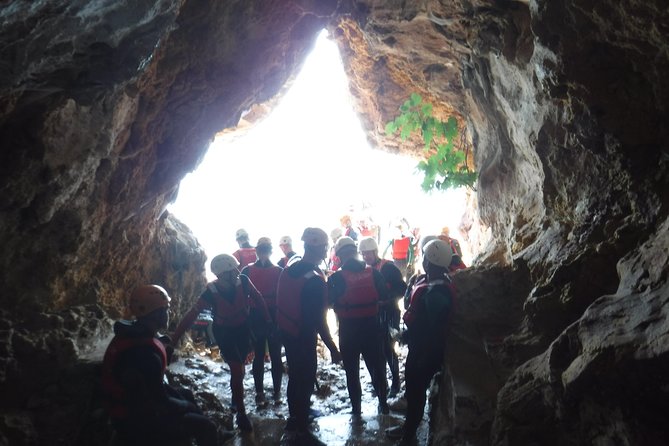
The activity is offered in English, and the guides are central to its appeal. The strongest accounts focus on guides who were both friendly and firm about safety. That combination matters more here than a theatrical style or constant encouragement.
A good guide does not simply tell you to jump. They explain where to place yourself, how to approach the water, and when to wait. They also watch the group closely enough to offer a lower option when someone needs it.
The maximum group size is 50 people. That is a significant number for a hands-on coastal activity, although the actual group may be smaller. If you prefer a quiet outing with lots of individual attention, ask about the expected group size when booking.
For families, the format can work well because teenagers and adults can share the same outing while taking different levels of challenge. The example of a family of five with three teenagers suggests that the activity can suit a broad age range, but the data does not state a minimum age. Check the current booking conditions if you are bringing young children.
Most people can participate, according to the supplied information, but that should not be read as a promise that the route feels easy for everyone. The activity includes physical effort, water exposure, and rocky movement. A reasonable level of fitness will help.
What the $84.69 price really covers
At $84.69 per person, this is not a cheap beach activity. The price makes more sense when you count the equipment, guide support, and range of activities included in the four-hour session.
You receive a thermal costume, helmet, harness, life jacket, gloves, bottled water, energy bars, and additional snacks. Those inclusions reduce the amount of specialist equipment you need to source yourself. You are also paying for a structured route through a demanding coastal environment, not simply access to a jump spot.
The value is strongest if you plan to use the full mix of activities. Someone interested only in a quick swim or one cliff jump may find the cost high. Someone who wants climbing, rappelling, a cave, a slide, hiking, swimming, and a zip line in one morning or afternoon gets a fuller package.
Lunch and dinner are not included. Water and energy snacks are supplied, but you should not treat those as a meal. Plan food around the four-hour session, especially if you are bringing active teenagers or anyone who needs regular meals.
Group discounts may improve the price for families or larger parties. Since the activity is often booked about 12 days ahead, booking early is sensible if your dates are fixed.
Who should book this coasteering trip
I would put this near the top of the list for active families, couples, and friends who want a half-day with real physical variety. It is particularly suitable if your group includes someone who is curious but nervous, since the guides appear willing to scale the jumps and coach technique.
It also suits people who would rather do something in the scenery than look at it from a road or viewpoint. The route gives you a close, physical connection with the Arrábida coast.
I would think twice if you dislike cold water, heights, uneven rock, or being part of a group. You may be able to skip a high jump, but the overall activity still involves swimming, climbing, hiking, and wet equipment.
It is also not the right pick if you want a quiet cultural excursion. Forte de Santa Maria da Arrábida and Lapa de Santa Margarida add interest, but the focus remains outdoor action.
Practical details before you go
The meeting point is Rua do Portinho da Arrábida, R. do Portinho da Arrábida, 2925 São Lourenço, Portugal. The activity ends back at that same point, which simplifies planning.
You receive booking confirmation at the time of reservation, and a mobile ticket is available. English is the offered language.
Free cancellation is available if you cancel at least 24 hours before the start time. Changes made less than 24 hours before the start are not accepted, and late cancellations are not refunded. Since good weather is required, a cancellation by the operator because of poor conditions brings the choice of another date or a full refund.
The activity can take up to 50 people, so ask about the expected group size if personal attention is a priority. Group discounts may help reduce the per-person cost for a family or larger party.
Should you book Portinho da Arrábida coasteering?
Book it if you want a lively half-day that combines cliff jumps with genuine coastal movement, not just a single thrill ride. The supplied equipment, snacks, English instruction, and same-place return make the outing straightforward, while the guides’ patient handling of nervous participants is a strong point.
Skip it if your idea of a holiday is keeping your clothes dry or avoiding physical effort. For everyone else, the mix of the fort, cave, swimming, climbing, rappel, slide, and zip line gives you plenty for the price. Bring a willing attitude, tell the guides your limits, and let the route build your confidence one challenge at a time.
FAQ
Where does the coasteering activity take place?
It takes place at Portinho da Arrábida in the Setubal District of Portugal, within the Serra da Arrábida Natural Park.
How long does the activity last?
The session lasts approximately four hours.
Where do I meet the group?
The meeting point is Rua do Portinho da Arrábida, R. do Portinho da Arrábida, 2925 São Lourenço, Portugal.
Where does the activity finish?
It ends back at the original meeting point.
What activities are included?
The route includes cliff jumping, rock climbing, rappelling, a slide, a cave visit, swimming, and hiking. A zip line is also described as part of the experience.
What safety equipment is provided?
You receive a 5mm thermal costume, helmet, harness, life jacket, and gloves.
Are food and drinks included?
Bottled water, energy bars, and snacks are included. Lunch and dinner are not included.
Is the activity offered in English?
Yes. English is the offered language.
Can most people participate?
The activity information states that most participants can take part. The route still includes physical activity, swimming, climbing, and uneven rock.
What happens if the weather is poor?
The activity requires good weather. If it is canceled because of poor conditions, you will be offered another date or a full refund.
What is the cancellation policy?
You can cancel for a full refund up to 24 hours before the start time. Cancellations or changes made less than 24 hours before the start are not accepted for a refund.
How large can the group be?
The maximum group size is 50 people.
New around Setubal District
- Lisbon: Kayaking and snorkeling in Sesimbra with photos!★ 5.0 · 74 reviews
- Portinho da Arrábida: Coasteering Boat Tour★ 4.9 · 78 reviews
- Arrábida: Guided Transparent Kayaking Tour★ 5.0 · 81 reviews
- Sesimbra Discovery by Kayak★ 5.0 · 84 reviews
- Évora: Private walking tour, By Local Guide★ 5.0 · 87 reviews
- Lisbon: Try Scuba Diving in Arrabida Marine Reserve with photos★ 5.0 · 99 reviews
- Arrábida Secret Beaches and Caves with Snorkeling Stop★ 5.0 · 109 reviews
- Melides: Horse Riding on the Beach with Wine Tasting★ 4.3 · 117 reviews
Setubal District Tours, compared.

Arrábida Dolphin and Whale Watching tour with biologist
Read our review →
Observation of Dolphins and Whales with Marine Biologist in Arrábida
Read our review →
Private walking tour with tickets to main monuments
Read our review →
Browse the lists this tour appears in