
Reviewed · WALKING TOURS
Lisbon: Starter Walking Tour to the highlights in German
Lisbon reveals itself quickly on foot, and this two-hour German-language walk gives you a useful first look at its historic center. You move from Rossio Square through Baixa, Chiado, and Bica, passing the Santa Justa Lift, Carmo Convent Ruins, and the steep Elevador da Bica route before finishing near the Tagus at Time Out Market.
I like the small groups of up to 12 and the way the tour mixes old sights with present-day Lisbon. I also like that your guide discusses daily life, current events, food, and places to explore after the walk. The main drawback is the pace: two hours covers a lot, so you get orientation and context rather than long visits inside each sight.
Key Points
- German-speaking local guidance: Ask questions about Portuguese culture, Lisbon life, and the city’s past and present.
- A compact central route: Walk through Baixa, Rossio, Chiado, Bica, and the area around the Tagus River.
- Major sights without a long commitment: See the Santa Justa Lift, Carmo Convent Ruins, and Elevador da Bica in two hours.
- A small group format: The shared tour accepts no more than 12 participants, with a private option available.
- Useful food and sightseeing advice: Finish at Time Out Market with tips for the rest of your stay.
- Some uphill walking: Bring water and comfortable shoes, and expect stairs and sloped streets.
Why This Short Lisbon Walk Works as a First Tour
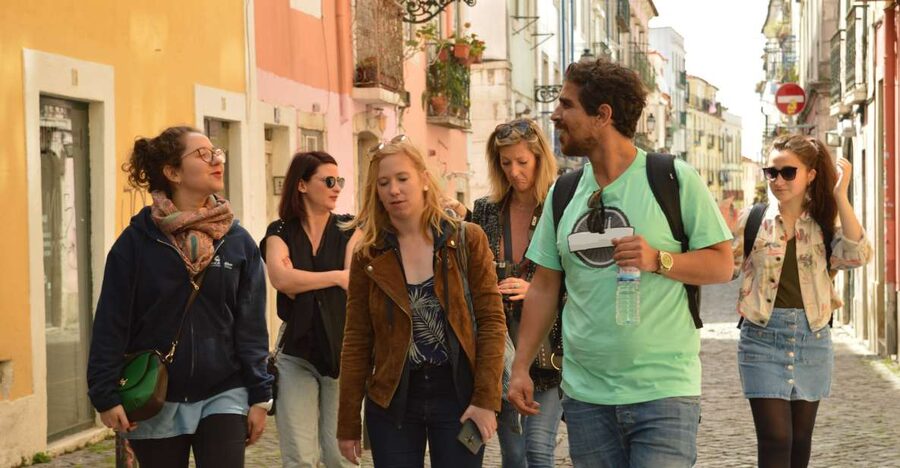
Lisbon can feel confusing at first. Its central neighborhoods sit on hills, streets change names as they climb, and the most famous sights are often tucked behind ordinary-looking corners. This walk gives you a simple map of the city center while placing its landmarks in a wider story.
You meet at Rossio Square, then move through Baixa, Chiado, and Bica. That route matters because these districts show different sides of Lisbon. Baixa is the orderly downtown rebuilt after the 1755 earthquake. Chiado brings grand shops, cafés, theaters, and Art Nouveau details. Bica gives you a taste of the hillier streets for which Lisbon is famous.
The tour is conducted in German, which makes a difference if you want more than a quick list of dates and names. You can ask about local customs, current life, and practical matters in your own language. The guide also offers advice on where to eat and what to see next, making the walk useful beyond its final stop.
The strongest praise has centered on the guides’ friendly manner, clear explanations, and openness to questions. Pedro, in particular, is noted for being friendly, well informed, and happy to discuss the city. That conversational approach suits this kind of introduction better than a rigid lecture.
More Walking Tours in Lisbon
- Lisbon: History, Stories and Lifestyle Walking Tour
★ 4.8 · 10,902 reviews - Best of Lisbon Small-Group Guided Walking Tour
★ 5.0 · 4,869 reviews - Lisbon: Food and Wine Small Group Walking Tour
★ 4.9 · 4,082 reviews
Meeting at Rossio Square’s North Fountain
The meeting point is the northern fountain in Rossio Square, officially Praça Dom Pedro IV. Look between the National Theater and the statue of the Royal figure. Your guide will wear a mint-colored WALK ’N’ ROLL shirt or carry a matching mint-colored burlap bag.
This is a sensible place to begin because Rossio is one of the clearest reference points in central Lisbon. Still, give yourself enough time to find the correct fountain. The square has several open areas and fountains, and the city center can be busy with pedestrians.
Rossio also gives your guide an easy starting point for explaining Lisbon’s layout. From here, you can begin to understand how Baixa extends toward the river, while Chiado and Bica rise to the west. You will not need transportation during the tour. The entire route is walked.
Baixa: Lisbon’s Orderly Downtown
The first neighborhood is Baixa de Lisboa. Its broad streets and planned blocks feel different from the winding lanes elsewhere in the city. Here, the guide can explain how Lisbon’s center was reshaped after the 1755 earthquake, giving the area a practical urban form that is easy to read as you walk.
Baixa is also a good place to hear about life in Lisbon today. The tour is not limited to monuments. You can ask about Portuguese culture, local routines, current events, and the city’s changing character. Those details help you see the streets as more than a backdrop for photographs.
Expect to keep moving. This is a walking orientation, not a stop-by-stop museum visit. If you want extensive time inside churches, museums, or historic buildings, you will need to return on your own.
Rossio Square and the Shape of Central Lisbon
Although Rossio is the starting point, it also receives a guided explanation as part of the route. The square connects several important streets and works as a natural crossroads for the historic center.
Your guide can help you notice the small details that are easy to miss when you are finding your way around. Lisbon’s decorative paving, tiled façades, and layered architecture become more meaningful when someone explains how they fit into the city’s story.
You should also use this early part of the walk to ask practical questions. If you are unsure where to eat, which neighborhood to explore next, or how to spend the rest of your day, this is the sort of tour where those questions are welcome.
More walking tours around Lisbon:
- Best of Lisbon Walking Tour: Rossio, Chiado & Alfama
★ 4.9 · 2,700 reviews - Age of Discoveries Walking Tour in Belém
★ 5.0 · 1,513 reviews - Sintra & Cascais Day Tour with Pena Palace Entry and Gardens Walk
★ 5.0 · 962 reviews - Lisbon Roots – Small group Food & Culture Walking Tour w/tastings
★ 5.0 · 910 reviews
The Santa Justa Lift and Carmo Convent Ruins
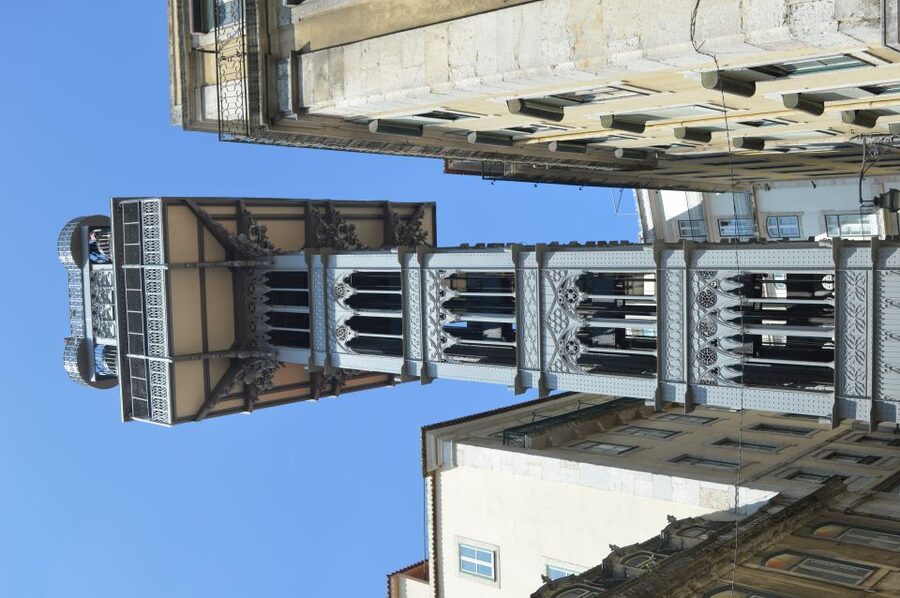
The Santa Justa Lift is one of Lisbon’s most recognizable structures. Its iron frame and vertical design connect the lower streets of Baixa with the higher Carmo area. The tour takes you to the lift and explains its place in the city rather than treating it as an isolated photo stop.
The lift can attract attention because it offers both an unusual piece of transport history and a strong visual marker in the old center. Depending on conditions and timing, you should not assume that riding it is part of this walking experience. The included activity is a guided walk, and no ride is listed.
Nearby, the Carmo Convent Ruins provide one of the most memorable settings on the route. The roofless arches make the effects of the 1755 earthquake visible in a way that a simple date on a timeline cannot. You will hear about the site as part of Lisbon’s past, while also seeing how it remains woven into the modern center.
The short format means you will likely view the ruins from the route rather than spend a long period exploring every corner. That is fine for a first introduction, but plan a separate visit if the convent is high on your list.
Chiado and Lisbon’s Tile-Covered Streets
From the Carmo area, the walk continues into Chiado. This neighborhood is known for its polished urban architecture, shops, cultural venues, and cafés. It also gives you a chance to see how Lisbon’s older buildings use decorative details to create a distinct local style.
One of the tour’s recurring themes is the Portuguese wall tile, or azulejo. These tiles do more than decorate façades. They add color, pattern, and protection to buildings, and they are among the easiest parts of Lisbon’s visual character to miss if you only rush between major landmarks.
The route also points out Art Nouveau architecture. In a two-hour walk, you will not study every building in detail, but your guide can show you what to look for. Afterward, you will have a better eye for tiled walls, ironwork, curved lettering, and decorative façades as you continue exploring alone.
Chiado is also a good place for questions about modern Lisbon. The guide discusses present-day life rather than stopping at the city’s historic dates. That balance is useful if you want to understand how the central neighborhoods function now.
Praça Luís de Camões and the Move Toward Bica
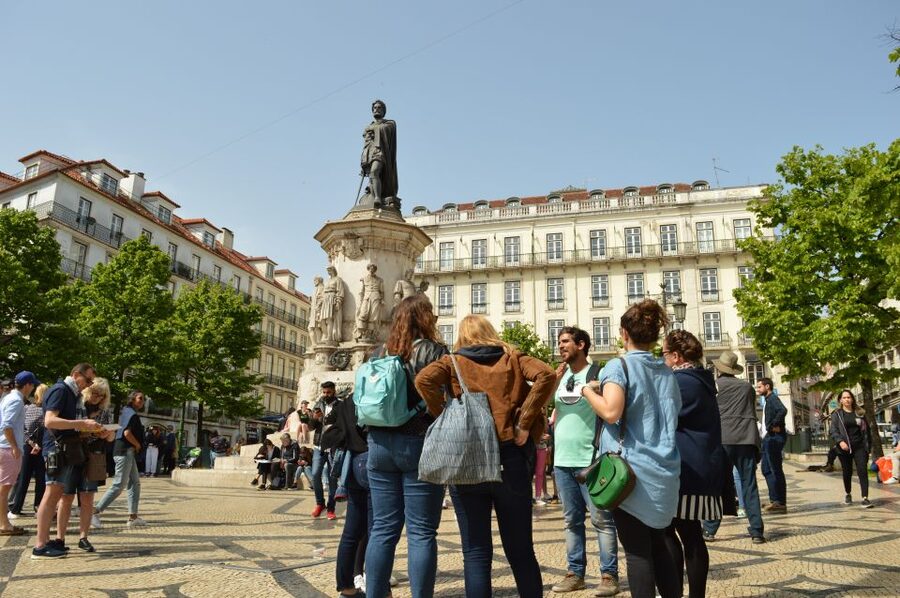
The route reaches Praça Luís de Camões, a key square between Chiado and the Bica area. Here, the city begins to feel more visibly hilly, and the walk changes from broad downtown streets to a more vertical part of Lisbon.
This section helps explain why Lisbon’s elevators and funiculars are not just tourist ornaments. They respond to a real city built across steep slopes. You will begin to see how the transport network connects neighborhoods that would otherwise require tiring climbs.
The tour includes a special viewpoint with views across the city. The exact viewpoint is not specified, so you should think of it as a scenic pause rather than a promised named lookout. It gives the route a welcome visual break and helps you connect the streets you have walked with the wider city.
The Elevador da Bica and Lisbon’s Hills
The Elevador da Bica is one of the route’s most atmospheric stops. This cable car runs through a steep street in Bica, an area closely tied to Lisbon’s hilltop geography. Even if you do not ride it, seeing the route helps explain the city’s famous yellow transport vehicles and steep lanes.
You should be ready for uneven ground, slopes, and a few stairs. A moderate level of fitness is required, and the experience is not suitable for wheelchair users or people with mobility impairments. Baby strollers and luggage or large bags are also not allowed.
Wear shoes that can handle paving stones and inclines. Bring water and sunscreen, especially if you are walking during a warm part of the day. If rain makes the slopes slippery, the final 30 minutes may be changed to avoid accidents. That is a sensible safety adjustment, but it may mean the route differs from the usual plan.
Arriving at Mercado da Ribeira and Time Out Market
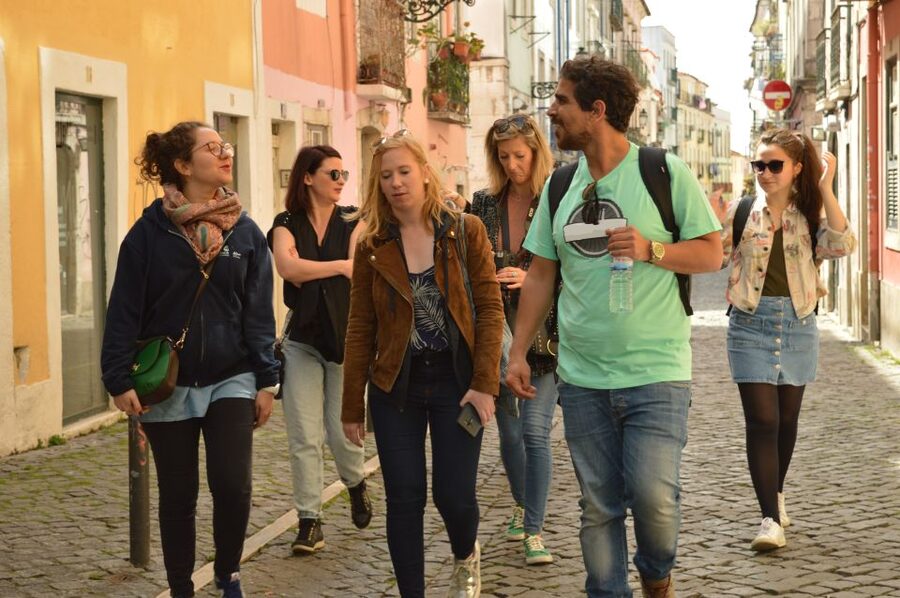
The tour ends at Mercado da Ribeira, now known as Time Out Market Lisboa, near the Tagus River. This is a practical finishing point. You can continue your day with food, a look around the market hall, or a walk toward the river.
Food and drinks are not included, so budget separately if you want to eat after the tour. The guide can offer tips on places to eat and other parts of Lisbon to explore, but you choose and pay for your own meal.
Ending here also gives the walk a useful contrast. You begin among historic squares and earthquake-era streets, then finish in a modern market hall connected to Lisbon’s current food and social life. It is a good place to continue without needing to find another neighborhood or arrange transport.
What Two Hours and $33 Really Buy You
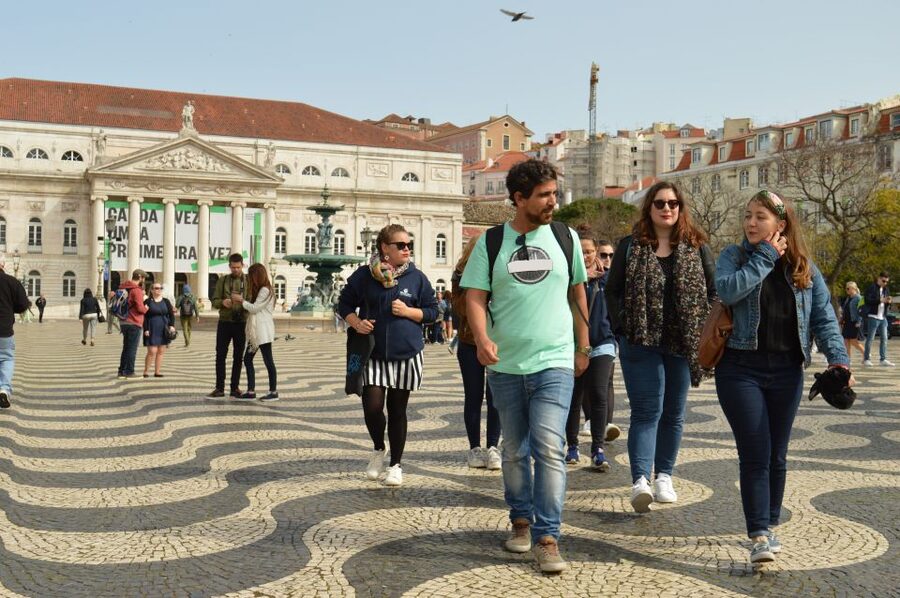
At $33 per person, this tour is priced as a paid orientation rather than a full-day sightseeing package. You are paying for a local guide, a German-language explanation, a carefully arranged central route, and advice that can shape the rest of your stay.
The value is strongest if this is your first time in Lisbon, if you want to get your bearings quickly, or if you prefer asking questions in German. A maximum of 12 people keeps the group small enough for questions without the cost of a fully private experience.
The time limit is also the main tradeoff. You will see many important places, but you will not have long at each one. The tour does not include food, drinks, hotel pickup, or drop-off. You also need to pay separately for any attraction admission or transport ride if you choose to return later.
A private tour is available if you want the guide’s attention focused on your own group. That option may suit families, friends, or anyone who wants a slower pace, but the supplied price of $33 applies to the shared per-person experience.
Free cancellation is available up to 24 hours before the start, and you can reserve now while paying later. Those terms are useful if your Lisbon plans are still shifting.
Who Will Get the Most from This German Tour
I would choose this walk if you want a fast but meaningful introduction to central Lisbon. It fits well on your first day, when you need a map of the city and a short list of places to revisit.
It is also a strong choice for German-speaking visitors who want more detail than a self-guided walk can offer. You can ask about daily life, Portuguese culture, current events, food, and local customs without worrying about language gaps.
The tour is less suitable if you want long museum visits, a relaxed photo walk, or a route designed for limited mobility. The hills and stairs are part of the experience, not a minor footnote. If you have only a short time in Lisbon, though, the compact route makes good use of two hours.
Practical Tips Before You Go
- Arrive at the northern fountain in Rossio Square and look for the mint-colored shirt or bag.
- Wear comfortable shoes with good grip.
- Carry water and sunscreen.
- Leave large bags and luggage behind.
- Do not bring a baby stroller.
- Expect a moderate amount of walking, some stairs, and sloped streets.
- Treat the market stop as a chance to buy your own food, since meals are not included.
- Ask your guide for suggestions for the rest of your stay. The walk is designed to give you more than landmarks.
FAQ
Is the Lisbon walking tour conducted in German?
Yes. The live tour guide language is German.
How long does the tour last?
The walking tour lasts two hours.
Where does the tour begin?
Meet at Rossio Square, also called Praça Dom Pedro IV, at the northern fountain between the National Theater and the Royal Statue.
Where does the tour finish?
The walk finishes at Time Out Market Lisboa, also called Mercado da Ribeira, near the Tagus River.
What sights are included on the route?
The route includes Baixa, Rossio Square, the Santa Justa Lift, Carmo Convent Ruins, Chiado, Praça Luís de Camões, the Elevador da Bica, and Mercado da Ribeira.
Is the tour suitable for people with mobility impairments or wheelchair users?
No. The tour requires a moderate level of fitness, including walking for the full two hours and climbing a few stairs. It is not suitable for people with mobility impairments or wheelchair users.
Should You Book This Lisbon Walk?
Book it if you want a compact German-speaking introduction to Lisbon’s historic center, especially at the start of your stay. The mix of major landmarks, tiled architecture, city views, local context, and practical advice gives you a useful base for exploring on your own.
Skip it if you need an accessible route, dislike hills, or want extended time inside individual sights. For everyone else, the $33 price is reasonable for a small-group walk that covers several central neighborhoods in two hours. The best reason to choose it is not simply the number of landmarks. It is the chance to ask a local guide, such as Pedro, how Lisbon works today, then leave with a clearer plan for the rest of your visit.
New around Lisbon
- Arrábida, Setúbal, Sesimbra, Olive with wine tasting★ 5.0 · 75 reviews
- Lisbon: Sunset Sailing Boat Cruise with Wine★ 5.0 · 75 reviews
- Lisbon Half Day Private Tour★ 5.0 · 75 reviews
- Private Half Day Tour to Fatima from Lisbon★ 5.0 · 75 reviews
- Fátima, Nazaré and Óbidos Private Tour from Lisbon★ 5.0 · 76 reviews
- Central Lisbon 3-Hour Guided E-Bike Tour★ 4.8 · 76 reviews
- Lisbon Historic City Tour by Tuk-Tuk★ 5.0 · 76 reviews
- Sintra World Heritage and Cascais Village Private Deluxe Tour★ 5.0 · 76 reviews
Walking Tours, compared.


Best of Lisbon Small-Group Guided Walking Tour
Read our review →

Porto Walking Tour, Lello Bookshop, River Cruise and Cable Car
Read our review →

Best of Lisbon Walking Tour: Rossio, Chiado & Alfama
Read our review →
Experience Porto’s Charm: 3-Hour Guided Walking Tour
Read our review →
Enjoy a Guided Levada Walk in the Rabaçal Valley
Read our review →Browse the lists this tour appears in