
Reviewed · CITY TOURS
Lisbon Walking Tour – The Perfect Introduction to the City
Lisbon’s past comes at you quickly on this 2.5-hour walk through Baixa, Rossio, Chiado, and Bairro Alto. You’ll hear how the 1755 earthquake reshaped the city, see the ruins of Carmo Church, and follow the story of the Carnation Revolution, all while moving through Lisbon’s main downtown streets.
I like two things right away: the route gives you a useful first look at the city, and the guides add practical advice about restaurants, viewpoints, and getting around. Guides such as Tiago, José, Natalia, Walter, and Kate are repeatedly praised for lively storytelling and local suggestions. The main consideration is the tip-based format. The advertised booking price is only $1.25, but one guide reportedly asked for a minimum €10 contribution, so clarify expectations before you set off.
Key things to know before you book
- The route covers Lisbon’s essential center: Praça do Comércio, Rossio, Chiado, Carmo, and Bairro Alto all appear in one outing.
- The 1755 earthquake gets proper attention: You’ll learn how the disaster changed Lisbon’s buildings, streets, and city planning.
- Carmo Church and the Carnation Revolution add unusual depth: This is more than a monument checklist.
- Guides are a major part of the experience: Tiago and José receive especially warm praise for humor, energy, and clear storytelling.
- The walk runs in rain: Bring an umbrella or rain poncho, and wear comfortable shoes.
- The tip system needs a little care: The low upfront price does not represent the guide’s full expected payment.
Why this is a smart first look at Lisbon
Lisbon can feel confusing on your first morning. The downtown grid is easy enough, but the city quickly tilts uphill toward Chiado and Bairro Alto. This walk gives you a mental map before you spend time choosing trams, restaurants, viewpoints, and museums.
The route also links several periods of Portuguese history. You begin with royal power and maritime commerce at Praça do Comércio, move into the rebuilt city after the 1755 earthquake, then hear about religious persecution, the Carnation Revolution, and modern Lisbon nightlife.
I especially like the way the tour mixes major sights with places you might otherwise pass without understanding. A quick look at Rossio Station becomes a lesson in Lisbon’s architecture. A church becomes part of the city’s difficult past. A square in Chiado becomes the setting for a revolution.
The tour is conducted in English, and the group size is capped at 20 people. That is large enough to create energy but small enough for questions, at least when the group stays together. Since some guides speak quickly, position yourself close to the guide and ask for a slower pace if needed.
More City Tours in Lisbon
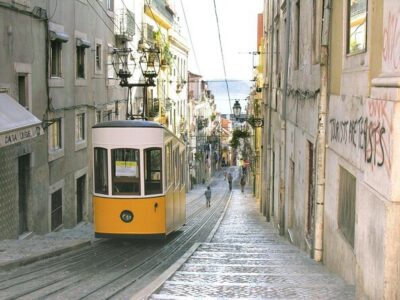
- Lisbon City Center Tour – The Unmissable Lisbon
★ 5.0 · 22,234 reviews - Lisbon: Daytime/Sunset/Night City Sailboat Tour with Drink
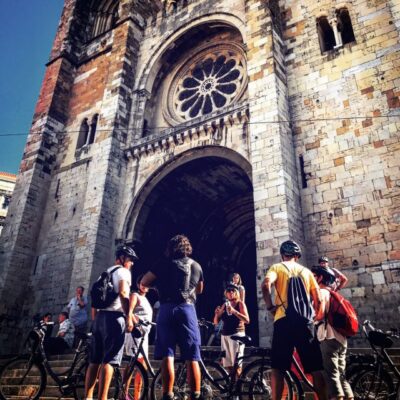
★ 4.9 · 3,114 reviews - Lisbon: City Highlights and Viewpoints E-Bike Tour
★ 4.9 · 1,556 reviews
Finding the orange umbrella at Praça do Comércio
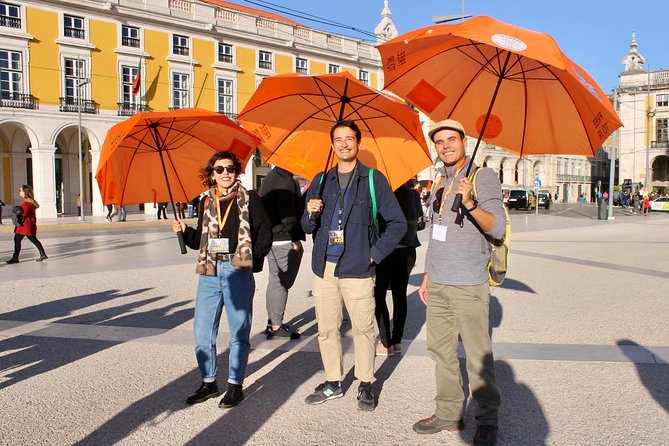
Your meeting point is Praça do Comércio, Lisbon’s huge riverside square. Look for the guide with an orange umbrella between the triumphal arch and the statue of King José I.
The opening portion lasts about 15 minutes and serves as both a welcome and a city orientation. The square is a good place to begin because its scale tells you something about Lisbon’s role as a port and royal capital. The statue in the center gives the starting point a clear landmark, while the arch frames the entrance toward Rua Augusta.
This is also the moment to listen carefully to the explanation of the payment system. The tour is marketed at $1.25 per person, but the guide is paid through a contribution at the end. Most people will need to budget more than the booking charge if they want to support the guide appropriately.
That arrangement can be excellent value when the guide delivers a strong tour. It can also feel awkward if the contribution is presented as a fixed minimum rather than a personal choice. One unhappy customer specifically objected to being told to pay at least €10. I would ask politely at the start how the system works, then decide what feels fair after seeing the tour.
Praça do Comércio and the rebuilt downtown
From the opening square, the walk continues to the Municipal Square, home of Lisbon’s city hall. These first stops are close together, so the tour can begin with a relaxed pace before the uphill sections arrive.
Praça do Comércio is more than a grand photo stop. Its open space and uniform buildings help explain the rebuilding of central Lisbon after the earthquake and tsunami of 1755. The event destroyed much of the old city, and the new downtown was laid out with wider, more orderly streets.
That change becomes clearer on Rua Augusta, Lisbon’s key pedestrian street. The route uses the street to connect the waterfront with Rossio, and your guide can point out how the downtown plan differs from the older, hillier neighborhoods.
Do not expect long visits inside buildings. The attraction here is the explanation given on the street. If you want to enter the arch, visit the Santa Justa Elevator, or explore a church in detail, plan separate time afterward.
Santa Justa Elevator and Rossio Square
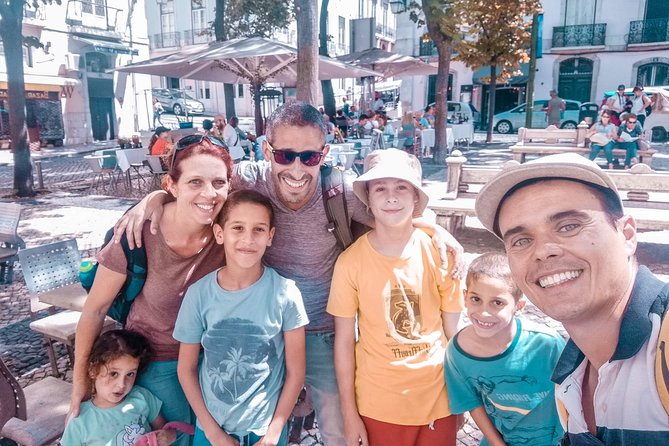
The Santa Justa Elevator is one of Lisbon’s most recognizable landmarks. The tour stops near it for about five minutes, enough to understand its place in the city but not enough for a ride or a long wait.
The elevator is especially useful as a visual marker. Its tall iron structure links the lower streets with the higher Carmo area, and it shows how Lisbon has always had to solve the problem of steep hills. The tour does not include admission, so treat this as an outside visit.
Next comes Praça Dom Pedro IV, usually called Rossio. The route describes it as Lisbon’s oldest square, and it has long served as a gathering place in the center of town. Here, the guide can help you read the patterns in the paving, the surrounding buildings, and the constant movement through the square.
Nearby, Rossio Station receives a short stop. Its ornate entrance is easy to miss if you are focused on finding a train, yet it is one of the city’s most memorable pieces of public architecture. The stop is brief, so take a moment to look up before the group moves on.
More Walking Tours in Lisbon
- Lisbon: History, Stories and Lifestyle Walking Tour
★ 4.8 · 10,902 reviews - Best of Lisbon Small-Group Guided Walking Tour
★ 5.0 · 4,869 reviews - Lisbon: Food and Wine Small Group Walking Tour
★ 4.9 · 4,082 reviews - Best of Lisbon Walking Tour: Rossio, Chiado & Alfama
★ 4.9 · 2,700 reviews
A difficult chapter at São Domingos Church
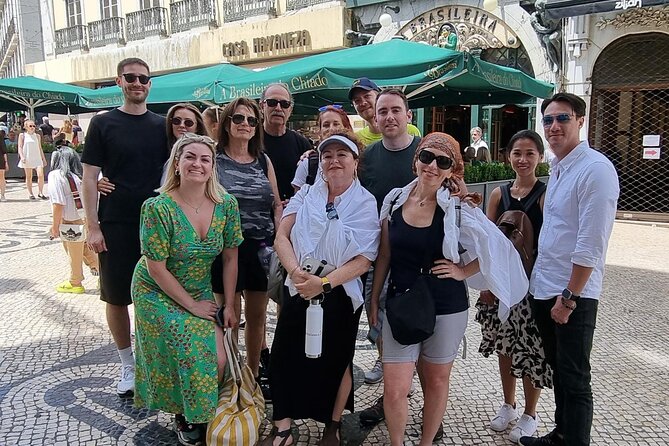
The walk then turns toward the Memorial to the Victims of the 1506 Jewish Massacre and Igreja de São Domingos. This is one of the strongest parts of the route for anyone who wants more than pretty streets.
The memorial honors thousands of Jewish victims killed during the massacre of 1506. It brings a painful chapter of Lisbon’s past into the open, and the placement beside the church makes the stop feel connected to the surrounding neighborhood rather than tucked away in a museum.
São Domingos Church is described as one of the city’s most impressive churches. Its interior has endured fire and earthquake damage, and it carries a visible sense of age and loss. The visit is primarily an outdoor explanation unless your guide’s timing allows you to look inside.
This section is a good example of the tour’s value. A guide can provide context in a few minutes that would otherwise take careful reading before your trip. It also gives you a reason to return later for a longer visit.
Avenida da Liberdade and Casa do Alentejo
Avenida da Liberdade is introduced as Lisbon’s most elegant avenue. The stop is short, so do not expect to walk its full length or study every building. Instead, you get a sense of the grand boulevard that links central Lisbon with the northern part of the city.
The route then reaches Casa do Alentejo, one of the most charming houses in Lisbon. This is a particularly useful recommendation because the building is easy to overlook from the street. Its interior has a reputation for decorative rooms and a strong regional identity, though the tour schedule may allow only a brief look.
If your guide mentions restaurants or places to return, make a note on your phone. Natalia is praised for inexpensive food suggestions, while Tiago’s restaurant recommendations appear repeatedly in the feedback. These tips may be one of the most useful takeaways for a short stay, especially if you have not yet chosen where to eat.
Carmo Square and the Carnation Revolution
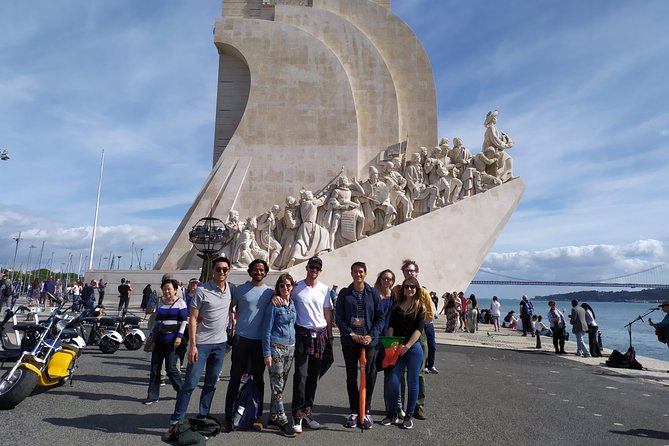
Largo do Carmo is one of the most meaningful stops on the route. It is tied to the Carnation Revolution of 1974, the peaceful military-led uprising that ended Portugal’s long dictatorship.
The square is also where the walk explains the Carmo Church ruins. The open roof and broken arches make the effects of the 1755 earthquake easy to grasp. Instead of seeing the disaster as a distant date, you see the physical remains in the middle of the city.
Guides often use this part of the walk for their best storytelling. Tiago is praised for animated explanations of the earthquake, the so-called cursed church, and the revolution. Other guides receive similar praise for making Portuguese history understandable without turning the tour into a classroom lecture.
The stop lasts about 10 minutes, but you may want to return later. Carmo is a useful place to pause, take photographs, or visit the archaeological museum if you have extra time. The walking tour itself does not include admission to paid attractions.
São Roque and the move into Chiado
Igreja de São Roque is described as one of the few churches in Lisbon to survive the 1755 earthquake. That makes it an important counterpoint to Carmo Church, where the damage is still visible.
The route gives you about 10 minutes here. The guide’s explanation is the main feature, so do not expect a full guided church visit unless the group’s schedule allows it. If ornate church interiors matter to you, mark São Roque for a return visit.
From there, the tour continues to Praça Luís de Camões, one of Lisbon’s best-known squares. This is where the route begins to feel more like Chiado, with its connection to cafés, shops, writers, and evening life.
The walk ends around Camões Square, which is a practical finishing point. You are close to Chiado and Bairro Alto, with easy access to restaurants, nightlife, and nearby public transportation. It is also a good place to continue exploring on your own rather than being left at an isolated attraction.
Bairro Alto after the main sights
The final stop is Bairro Alto, Lisbon’s famous nightlife quarter. The tour gives you a daytime introduction to the area, when you can understand its narrow streets and layout without dealing with the full evening crowd.
This is another reason to book the walk early in your stay. You can return after dark with a better sense of where Bairro Alto fits into the city. Just remember that the tour ends at Camões Square, not at a particular restaurant or bar.
The full route lasts about two and a half hours. It covers a lot of ground, but the walking is not described as extreme. One family managed the route with children and strollers, and another participant said the distance was reasonable. Still, Lisbon’s hills and uneven streets are real considerations. Comfortable shoes are essential.
The guides make the difference
The strongest part of this experience is the guide. Tiago receives especially frequent praise for his passion, humor, storytelling, restaurant advice, and ability to handle a large group. José is also singled out for warmth, energy, and strong explanations of Lisbon’s past.
Natalia is praised for combining history with inexpensive food suggestions. Kate is credited with finding places people might miss and following up with restaurant ideas. Walter is described as friendly, funny, and helpful with a family using strollers.
The experience will vary from guide to guide. Several people found one guide’s fast speech difficult to follow, especially when combined with an accent. If you have hearing concerns or English is not your first language, stay near the front, ask questions, and request a slower pace early.
The public rating is 4.8 from 538 reviews, with 97 percent recommending the experience. That is a strong record, but it does not erase the practical issues around speaking speed or tip expectations.
Weather, group size, and who should book
The tour operates in rain. If the forecast looks uncertain, bring a rain poncho or umbrella rather than assuming the walk will be canceled. One participant completed the route during heavy rain and still found it worthwhile, but wet stone streets can make the hills less pleasant.
The maximum group size is 20. That keeps the tour fairly manageable, though a group near the limit can make street-corner explanations harder to hear. The tour is near public transportation, service animals are allowed, and most people can participate.
I would choose this for a first visit, a short stay, or a morning when you want a useful orientation before making your own plans. It also suits history-minded visitors who prefer stories and context over long museum visits.
I would be more cautious if you want a slow photographic walk, extensive time inside churches, or a fully fixed price. This is a moving overview, not a detailed architectural tour.
Is the $1.25 booking price good value?
At $1.25, the upfront cost looks almost too low for a 2.5-hour guided walk. The catch is that the guide depends on your end-of-tour payment. Think of the booking price as a small reservation charge, not the total cost of the experience.
The value can be excellent. You receive a route through many of central Lisbon’s key areas, explanations of major events, and useful food and transport advice. A strong guide can save you time and help you decide which places deserve a second visit.
The tip structure is the one point I would handle carefully. The tour says you pay what you see fit, but at least one guide presented €10 as a minimum. That is not the same as a fully optional tip. Ask for a clear explanation at the beginning so you know what is expected.
Free cancellation is available up to 24 hours before the start time for a full refund. Changes or cancellations inside that window are not accepted for a refund, and the tour may be canceled if its minimum number is not reached.
Should you book this Lisbon walking tour?
Yes, if you want a lively first orientation to central Lisbon and you are comfortable with a tip-based tour. The route covers the city’s major downtown landmarks while adding less obvious subjects, including the 1506 massacre, the 1755 earthquake, and the Carnation Revolution.
Book it early in your stay so you can use the restaurant, viewpoint, and transportation suggestions afterward. Wear good shoes, bring rain protection, and stay close to the guide.
Skip it if you prefer a fixed-price tour or need a slow, highly structured presentation. For everyone else, the combination of location, history, and practical advice makes this an unusually useful introduction to Lisbon.
FAQ
Where does the Lisbon walking tour start?
The tour starts at Praça do Comércio in Lisbon. Look for the guide with an orange umbrella between the large arch and the statue in the middle of the square.
Where does the tour end?
The walk ends around Praça Luís de Camões, also called Camões Square, in the Chiado area.
How long does the tour last?
The tour lasts approximately 2 hours and 30 minutes.
What language is the tour offered in?
The tour is offered in English.
What sights are included?
The route includes Praça do Comércio, Municipal Square, the Santa Justa Elevator, Rossio, Rua Augusta, the Jewish Massacre Memorial, São Domingos Church, Avenida da Liberdade, Casa do Alentejo, Largo do Carmo, Rossio Station, São Roque Church, Praça Luís de Camões, and Bairro Alto.
Is admission included at the attractions?
The listed stops have free admission as part of the walking route. The tour does not state that paid entry to attractions is included.
How does cancellation work?
You can cancel up to 24 hours before the experience for a full refund. Cancellations or changes made less than 24 hours before the start time are not refunded or accepted.
New around Lisbon
- Arrábida, Setúbal, Sesimbra, Olive with wine tasting★ 5.0 · 75 reviews
- Lisbon: Sunset Sailing Boat Cruise with Wine★ 5.0 · 75 reviews
- Lisbon Half Day Private Tour★ 5.0 · 75 reviews
- Private Half Day Tour to Fatima from Lisbon★ 5.0 · 75 reviews
- Fátima, Nazaré and Óbidos Private Tour from Lisbon★ 5.0 · 76 reviews
- Central Lisbon 3-Hour Guided E-Bike Tour★ 4.8 · 76 reviews
- Lisbon Historic City Tour by Tuk-Tuk★ 5.0 · 76 reviews
- Sintra World Heritage and Cascais Village Private Deluxe Tour★ 5.0 · 76 reviews
City Tours, compared.
Lisbon City Center Tour – The Unmissable Lisbon
Read our review →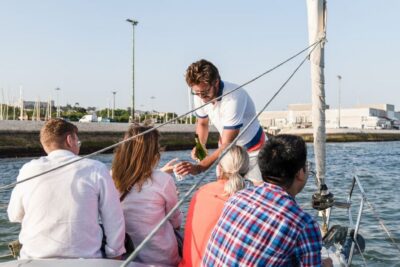
Daytime/Sunset/Night City Sailboat Tour with Drink
Read our review →
City Highlights 3-Hour Guided Electric Bike Tour
Read our review →

Browse the lists this tour appears in