
Reviewed · WALKING TOURS
3-Hour Private Guided Walking Tour of Lisbon
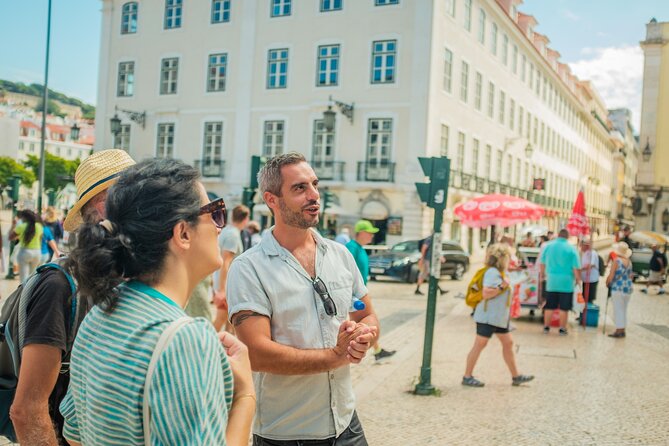
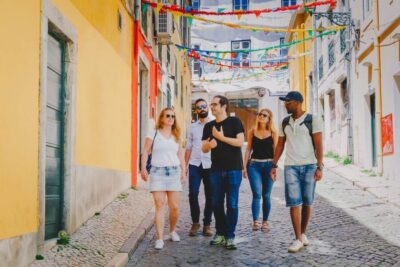
Lisbon reveals itself best on foot, and this route packs the city’s central story into three useful hours. You move from Rossio’s grand station through Mouraria and Alfama, then down toward the river and up into Chiado. Along the way, you get tiled streets, old churches, fado connections, and some of Lisbon’s finest viewpoints.
I like the private format, which lets your group of up to eight keep a sensible pace and ask questions without sharing the guide with strangers. I also like the route’s range: Mouraria, Alfama, Baixa, and Chiado each show a different side of Lisbon.
The main point to check is the language. The tour information says English is offered, but the additional details also state French only. Confirm this before paying, especially if language is central to your plans.
Key things to know before you book
- Rossio to Chiado in three hours: The walk crosses several of Lisbon’s most important central neighborhoods rather than staying in one small area.
- Private for up to eight people: The $204.38 group price becomes good value with a full party, but less so for one or two people.
- Fado appears in Mouraria: You’ll see the Monumento Mouraria Berço do Fado and Fado Vadio graffiti, though this is a walking visit, not a fado performance.
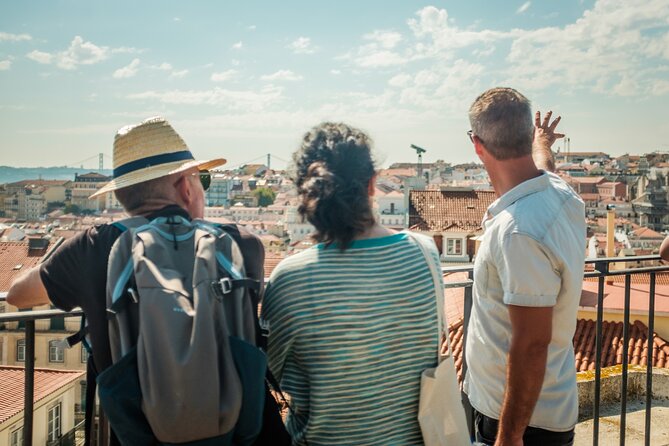
- Four strong viewpoints: Chão do Loureiro, Santa Luzia, Portas do Sol, and Praça do Comércio give the route plenty of visual variety.
- No major admission fees are included or needed: The listed stops are public squares, streets, viewpoints, and exterior sights, with the church and cathedral included as free stops on the route.
- A guide can add real value: Pedro is praised for his friendly manner and strong grasp of Lisbon’s past, if he is the person assigned to your walk.
Starting beneath Rossio Station
The meeting point is at the foot of the Teatro Nacional Dona Maria II, on Praça Dom Pedro IV. This is a handy central start, close to public transportation and easy to recognize once you reach Rossio.
Your first stop is Estação do Rossio, one of Lisbon’s prettiest railway stations. Its ornate facade gives you an immediate taste of the city’s taste for decorative stonework and dramatic entrances. You spend about ten minutes here, enough to look closely without letting the station swallow too much of a short tour.
From there, you step into Praça Dom Pedro IV, usually called Rossio. It is one of Lisbon’s key squares and a useful place to understand the city’s center. The open pavement, surrounding buildings, and steady movement of people make it a good orientation point before the walk turns into smaller streets.
A short stop at A Ginjinha adds a local food-and-drink detail. Ginjinha is Lisbon’s typical sour-cherry liqueur, and this visit is meant to introduce you to an authentic place associated with it. The stop lasts only five minutes, so think of it as a quick cultural pause, not a full tasting session or a leisurely drink.
More Walking Tours in Lisbon
- Lisbon: History, Stories and Lifestyle Walking Tour
★ 4.8 · 10,902 reviews - Best of Lisbon Small-Group Guided Walking Tour
★ 5.0 · 4,869 reviews - Lisbon: Food and Wine Small Group Walking Tour
★ 4.9 · 4,082 reviews
Praça da Figueira and the story of Mouraria

Praça da Figueira is described as the little sister of Rossio. The comparison makes sense as a way to read the two nearby squares together. You get ten minutes here, enough for the guide to explain how this part of central Lisbon fits into the city’s street plan.
Next comes Igreja de São Domingos, a small church that is easy to overlook if you are moving quickly between the major squares. The ten-minute stop gives it a fair chance. Smaller religious buildings often tell a more intimate story than the grand monuments, and this is one of the route’s quieter pauses.
Then the walk heads toward Mouraria, one of Lisbon’s most distinctive districts. The Monumento Mouraria Berço do Fado points to the neighborhood’s connection with fado, the Portuguese music known for its emotional singing and themes of longing. You are not being taken to a concert here. Instead, the guide uses the streets and markers of the district to explain its place in Lisbon’s cultural life.
The Fado Vadio graffiti adds another visual stop. It is a wall painting in Mouraria, scheduled for ten minutes. This is a small detail, but it helps keep the tour from becoming a parade of only grand squares and churches. You get a glimpse of how modern street art and older neighborhood traditions can share the same streets.
Chão do Loureiro gives you the first wide view
Miradouro Chão do Loureiro is one of the route’s useful pauses because it changes your view from street level to the broader shape of the historic center. You look across Lisbon from a belvedere rather than simply walking past another facade.
This stop is scheduled for ten minutes. That is enough time for photographs and a quick explanation, though you should not expect a long rest. The route has many stops, so the guide is working with a tight clock.
The view also helps you understand Lisbon’s uneven terrain. The city is not simply a flat grid between the river and the hills. The route’s regular climbs, descents, and lookout points are part of what makes the city attractive, but they also make comfortable shoes a practical choice.
Alfama, Santa Luzia, and Portas do Sol
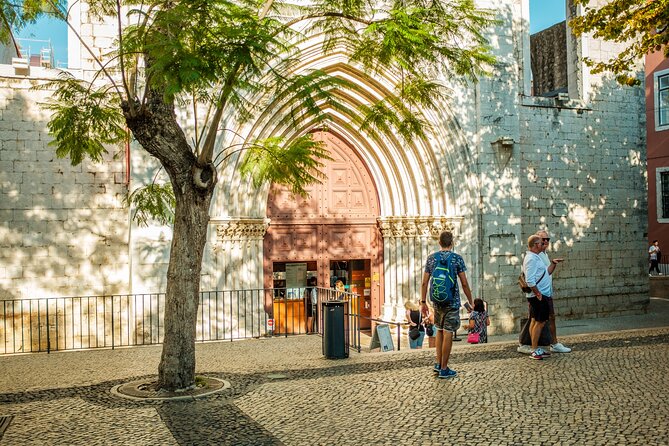
Alfama is the longest neighborhood visit, with about fifteen minutes set aside to explore its timeless character. The district is famous for its old streets and unusual layout, and it feels markedly different from the rebuilt central areas you visit later.
The important thing here is not just seeing a pretty lane. It is noticing the contrast between Alfama and Baixa. Alfama represents an older, more irregular part of Lisbon, while Baixa follows a more organized plan created after the 1755 earthquake. A guide can make that contrast easier to see in real time.
Miradouro de Santa Luzia follows with another fifteen-minute stop. This viewpoint looks over Alfama and gives you a chance to see the neighborhood from above. The stop is well placed in the route because you have just been walking through the district. You can connect the narrow streets below with the rooftops, walls, and river-facing views from the belvedere.
Nearby Miradouro das Portas do Sol offers a second angle. The two viewpoints are close together, but they are not pointless repeats. Seeing both helps you compare the views and gives the guide room to point out different parts of Alfama.
These lookouts are among the strongest parts of the walk. They also explain why a private guide is useful here. You can ask what you are looking at instead of taking a photograph and moving on without context. Still, the route allows only about ten minutes at Portas do Sol, so anyone wanting a long, quiet pause may find the schedule brisk.
A few other Lisbon half-days worth a look
- Lisbon: 3-Hour Tour by E-Bike
★ 4.8 · 1,150 reviews - 3-Hour Lisbon 7 Hills Electric Bike Tour
★ 5.0 · 818 reviews - 3-Hour Guided Street Art Walking Tour of Lisbon
★ 5.0 · 278 reviews - Lisbon: 3-Hour The Slave Trade – An Historical Walking Tour
★ 4.9 · 179 reviews
Lisbon Cathedral and the road toward Baixa
Lisbon Cathedral, or Sé de Lisboa, receives fifteen minutes. The tour describes it as the city’s most beautiful church, but beauty is personal, and the real value is its importance as a major landmark on the Alfama side of the center.
This is another place where you should clarify what your visit includes. The stop is listed as free, but the information does not specify an interior tour, a guaranteed entry, or time for a full visit. Treat it as a guided stop at the cathedral unless the guide tells you otherwise.
From the cathedral, the route moves into Baixa de Lisboa. This is the central district rebuilt after the earthquake of 1755. Its more orderly streets and broad avenues offer a clear change from Alfama’s older, twisting character.
I like this part of the route because it turns an architectural fact into something you can feel under your feet. You are not just hearing that Lisbon was rebuilt. You are moving from one kind of city plan into another.
Praça do Comércio and the Tejo
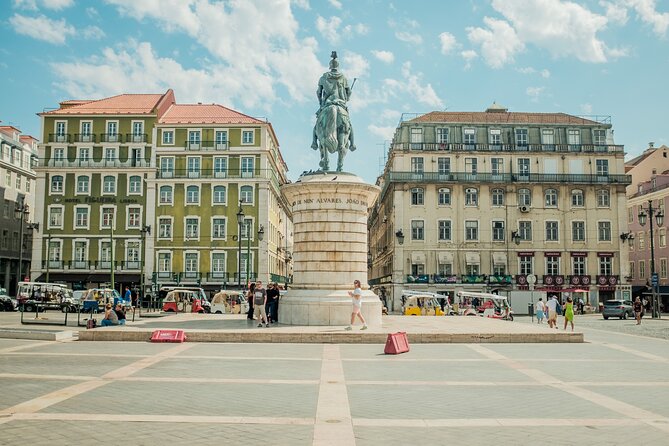
Praça do Comércio, also called Terreiro do Paço, gets fifteen minutes. This is one of Lisbon’s grandest public spaces, opening toward the Tejo River. The scale is a welcome change after the tighter streets of Alfama and the central squares around Rossio.
The square works well as a place to pause and take stock of the city. Behind you is Baixa and its rebuilt streets. Ahead is the river. That position gives the guide a natural way to explain Lisbon’s relationship with commerce, movement, and the waterfront, though the exact commentary depends on the person leading your group.
This is also one of the best photo stops on the route. You have enough scheduled time to look around rather than only pass through. If the walk is running late, this could be one of the places where the pace becomes faster, since the itinerary includes sixteen stops in total.
Chiado and the final stop at Praça Luís de Camões
The last neighborhood is Chiado, a more polished and fashionable part of central Lisbon. Its inclusion gives you one more contrast. The tour has taken you through old Alfama, traditional Mouraria, planned Baixa, and then into a more refined district.
The final stop is Praça Luís de Camões, where the tour ends at the foot of the statue. This is a sensible finish because it leaves you in Chiado, rather than sending you back to the starting point. You can continue exploring from there, though the tour itself ends at the square.
The stop is scheduled for fifteen minutes. That gives the guide time to close the story of the walk and answer final questions. It also means you finish near one of Lisbon’s central districts, with a clear sense of how the neighborhoods connect.
How much ground do you cover in three hours?
This is a sightseeing walk with a quick rhythm. The listed stops add up to roughly three hours, but most are brief, between five and fifteen minutes. You are sampling many places rather than spending a deep block of time inside any one church, museum, cafe, or neighborhood.
That approach suits a first visit. You get a strong outline of central Lisbon and can mark the places you want to revisit on your own. It is less suited to you if you prefer long café stops, detailed interior visits, or time to wander without a fixed schedule.
The route also includes hills and city streets. The information says most people can participate, but it does not give a specific distance or step count. Plan for ordinary city walking and wear shoes that can handle uneven pavement and inclines.
The private price and who gets good value
The cost is $204.38 per group for up to eight people. With eight people, that works out to about $25.55 each. With four people, it is about $51.10 per person. For two people, it rises to about $102.19 each.
That makes group size the key value question. A full family or group of friends gets a much better deal than a couple booking alone. In return, you get a private experience rather than a shared group walk, and your party can direct questions toward the guide.
The tour is also useful when your schedule is tight. Three hours gives you a city orientation without taking a full morning or afternoon. The route finishes in Chiado, so you can build your next activity around the endpoint.
The tradeoff is that the price does not appear to include a meal, a fado show, or paid attraction admissions. Its value comes from the guide’s time, the private format, and the route itself.
The guide and the language question
The strongest personal praise goes to Pedro, who is described as friendly, enthusiastic about Lisbon’s past, and able to bring several parts of the city into one walk. If Pedro leads your departure, you can expect a guide who enjoys explaining the city rather than simply naming buildings.
Do not assume he will be your guide, though. The supplied information does not guarantee a particular person. It also gives mixed language information: English appears among the tour features, while the additional details say French only.
That conflict is worth settling before booking. Ask the provider which languages are available for your date and who will lead the walk. A private tour loses much of its value if you cannot comfortably follow the explanations.
The provider is THIBAUT PAKIRY, UNIPESSOAL LDA. Confirmation is sent within 48 hours, subject to availability. Service animals are allowed, public transportation is nearby, and most people can participate.
Who should book this Lisbon walk?
I would consider this tour for a first-time visitor who wants to understand the central districts quickly. It is also a good fit for a family or friend group that can share the fixed fee and wants a guide focused on its own questions.
The route suits you if you enjoy:
- Seeing major landmarks without paying separate admission at every stop
- Learning how Alfama, Mouraria, Baixa, and Chiado differ
- Taking in several city views in one outing
- Linking fado with a real Lisbon neighborhood
- Finishing near Chiado rather than returning to Rossio
I would look elsewhere if your priority is a long fado performance, a food tour, museum interiors, or a slow photo walk. This is a broad city introduction, not a specialist tour.
Should you book it?
Book it if you want a private overview of Lisbon’s central core and can gather enough people to make the group price sensible. The route has a strong mix of viewpoints, neighborhoods, public squares, and cultural details, while the guide’s role can add the context that a self-guided walk often lacks.
Before booking, confirm the guide’s language, the exact meeting time, and what access you will have inside São Domingos Church and Lisbon Cathedral. If those details suit you, this is a practical way to get your bearings fast and choose where to spend the rest of your Lisbon stay.
Free cancellation is available when you cancel at least 24 hours before the start time. Changes or cancellations inside that window are not refunded.
FAQ
How long is the private Lisbon walking tour?
The tour lasts approximately three hours.
Where does the tour begin?
It begins at the Teatro Nacional Dona Maria II on Praça Dom Pedro IV in Lisbon.
Where does the tour end?
The tour ends at Praça Luís de Camões, at the foot of the statue.
How many people can join the private tour?
The price covers one private group of up to eight people.
What is the price?
The listed price is $204.38 per group of up to eight people.
Is the tour offered in English?
English appears among the tour features, but the additional information also says French only. Confirm the available language before booking.
Are admission tickets included?
The listed stops show free admission. The information does not specify paid entry into the interiors of the church or cathedral.
Is this tour suitable for most people?
The information says most people can participate. It does not provide a specific distance, step count, or detailed mobility assessment.
Are service animals allowed?
Yes, service animals are allowed.
Can I cancel for a full refund?
Yes, if you cancel at least 24 hours before the experience start time. Cancellations made less than 24 hours before the start are not refunded.
New around Lisbon
- Arrábida, Setúbal, Sesimbra, Olive with wine tasting★ 5.0 · 75 reviews
- Lisbon: Sunset Sailing Boat Cruise with Wine★ 5.0 · 75 reviews
- Lisbon Half Day Private Tour★ 5.0 · 75 reviews
- Private Half Day Tour to Fatima from Lisbon★ 5.0 · 75 reviews
- Fátima, Nazaré and Óbidos Private Tour from Lisbon★ 5.0 · 76 reviews
- Central Lisbon 3-Hour Guided E-Bike Tour★ 4.8 · 76 reviews
- Lisbon Historic City Tour by Tuk-Tuk★ 5.0 · 76 reviews
- Sintra World Heritage and Cascais Village Private Deluxe Tour★ 5.0 · 76 reviews
Walking Tours, compared.


Best of Lisbon Small-Group Guided Walking Tour
Read our review →

Porto Walking Tour, Lello Bookshop, River Cruise and Cable Car
Read our review →
Best of Lisbon Walking Tour: Rossio, Chiado & Alfama
Read our review →
Experience Porto’s Charm: 3-Hour Guided Walking Tour
Read our review →
Enjoy a Guided Levada Walk in the Rabaçal Valley
Read our review →Browse the lists this tour appears in